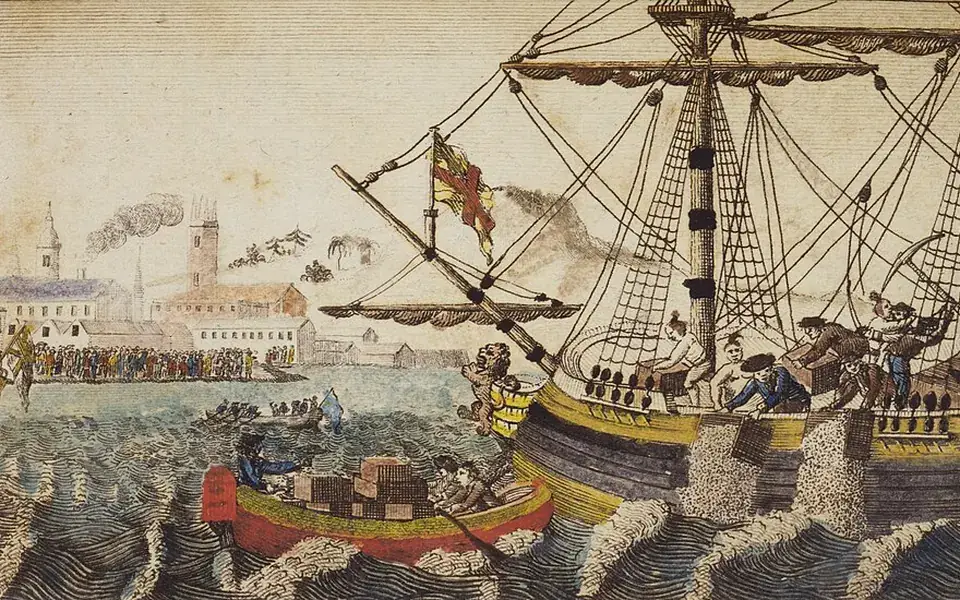
In 1773, protesters in Boston boarded ships carrying tea and dumped it into the harbor to oppose taxation and trade policies. The action became a major event in the colonial crisis. Britain subsequently imposed punitive measures, and colonial resistance grew. The event was bound up with economic interests, representation, and the governance of the empire.
Tea Act of 1773
The Indemnity Act of 1767, which gave the East India Company a refund of the duty on tea that was re-exported to the colonies, expired in 1772. Parliament passed a new act in 1772 that reduced this refund, effectively leaving a 10% duty on re-exported tea. The act also restored the tea taxes within Britain that had been repealed in 1767, and left in place the three pence Townshend duty in the colonies, equal to £1.32 today. With this new tax burden driving up the price of British tea, sales plummeted. The company continued to import tea into Great Britain; however, it amassed a huge surplus of product that no one would buy.
For these and other reasons, by late 1772, the East India Company, one of Britain's most important commercial institutions, was in a serious financial crisis. The severe famine in Bengal from 1769 to 1773 had drastically reduced the revenue of the East India Company from India, bringing the Company to the verge of bankruptcy. The Tea Act of 1773 was enacted to help the East India Company.
Eliminating some of the taxes was one obvious solution to the crisis. The East India Company initially sought to have the Townshend duties repealed, but the North ministry was unwilling because such an action might be interpreted as a retreat from Parliament's position that it had the right to tax the colonies. More importantly, the tax collected from the Townshend duties was used to pay the salaries of some colonial governors and judges.
Standoff in Boston
In every colony except Massachusetts, protesters were able to force the tea consignees to resign or to return the tea to England. In Boston, however, Governor Hutchinson was determined to hold his ground. He convinced the tea consignees, two of whom were his sons, not to back down.
When the tea ship Dartmouth arrived in the Boston Harbor in late November, Whig leader Samuel Adams called for a mass meeting to be held at Faneuil Hall on November 29, 1773. Thousands of people arrived, so many that the meeting was moved to the larger Old South Meeting House. British law required Dartmouth to unload and pay the duties within twenty days or customs officials could confiscate the cargo (i.e. unload it onto American soil). The mass meeting passed a resolution, introduced by Adams and based on a similar set of resolutions promulgated earlier in Philadelphia, urging the captain of Dartmouth to send the ship back without paying the import duty. Meanwhile, the meeting assigned twenty-five men to watch the ship and prevent the tea – including a number of chests from Davison, Newman and Co. of London – from being unloaded.
Destruction of the tea
While Samuel Adams tried to reassert control of the meeting, people poured out of the Old South Meeting House to prepare to take action. In some cases, this involved donning what may have been elaborately prepared Mohawk costumes. While disguising their individual faces was imperative, because of the illegality of their protest, dressing as Mohawk warriors was a specific and symbolic choice. It showed that the Sons of Liberty identified with America, over their official status as subjects of Great Britain.
That evening about 6 or 7 o'clock a large group of 30 to 130 men or more, armed with axes and some dressed in the Mohawk warrior disguises, went to the wharves where the tea ships were and boarded the three vessels. Over the course of three hours they dumped all 340 or 342 chests of tea into the water. The precise location of the Griffin's Wharf site of the Tea Party has been subject to prolonged uncertainty; a comprehensive study places it near the foot of Hutchinson Street (today's Pearl Street). The property damage amounted to the destruction of 92,616 pounds (42,010 kg) of tea, reported by the British East India Company to be worth £9,659, equivalent to £1,276,141 ($1,748,138) in 2025.