A familiar board with an earlier inventor
A circuit of property spaces, a jail, and payments demanded by a landlord may sound like the ingredients of Monopoly. They also belong to a much earlier invention. On January 5, 1904, the United States Patent Office granted Lizzie J. Magie a patent for a game board she called The Landlord's Game. The application had been filed the previous March. Her invention was intended to entertain, but it also belonged to a campaign about how society distributed wealth. A household amusement could become a small working argument about economic power.
Elizabeth Magie was interested in the ideas of Henry George, the political economist associated with a tax on land value. George argued that increasing land values could enrich owners even when the surrounding community supplied much of the improvement. Magie wanted players to encounter the consequences of ownership rather than simply read a lecture about them. The distinction between money earned through work and money received through controlling access to land supplied an organizing question. A game could repeatedly put that question in front of people making apparently ordinary moves.
Economics in the path of a token
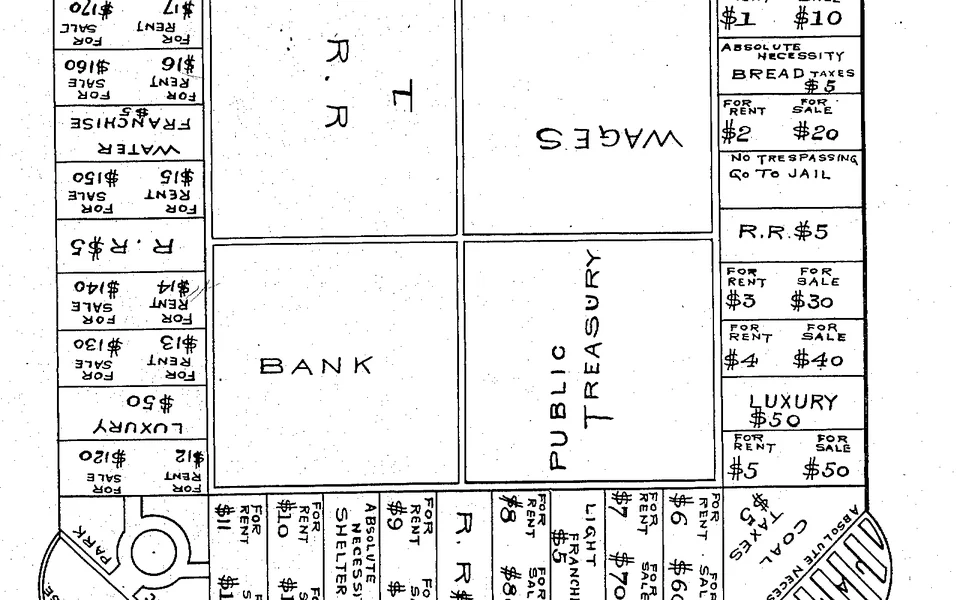
The 1904 patent offers unusually concrete evidence of what she designed. Its board contained lots for purchase or rent, transportation spaces, utility franchises, and areas representing basic necessities such as bread and clothing. Players received wages when they completed a circuit. Cash and property were counted to determine a winner after an agreed number of rounds. These details are worth reading individually because the early game was not identical to the familiar commercial Monopoly board. Some mechanisms changed as the design passed between players, publishers, and later inventors.
A token's landing place could alter a player's finances without reflecting that player's effort. Stop on someone else's property and rent was due; hold the property yourself and the same stop had different consequences. Other spaces directed payments toward a public treasury. The contrast made a political discussion available through action: who received a payment, and what rule made that recipient entitled to it? Chance moved the pieces, but the rules determined what chance meant. This is an interpretation of the design's teaching method, rather than proof that a board game can reproduce a complete economy.
One game travels through many hands
Magie continued revising her work. A second patent, issued in September 1924 under her married name, Elizabeth Magie Phillips, explicitly described an educational purpose alongside amusement. Its explanation linked the landlord's advantage with a proposed remedy through land taxation. Accounts of her broader project describe contrasting approaches to play, allowing different arrangements of ownership and payments to be compared. The patent records keep the chronology clear: her documented work preceded the 1930s commercial success of Monopoly by decades, even though later popular histories often began with a different inventor.
Between those dates, property-trading games circulated through networks of friends and players. People copied boards, taught rules, and changed details. The version associated with Atlantic City acquired local street names before reaching Charles Darrow. Parker Brothers marketed Darrow's Monopoly in 1935, making it a spectacular commercial success. This history involves both Magie's identifiable invention and a collective process of adaptation. A patent can establish a particular design at a particular time, but it cannot by itself describe every kitchen-table conversation through which a game was altered and passed along.
Reading the rules behind the legend
The accompanying image shows a cropped detail of Magie's original patent drawing, rather than a modern Monopoly board. The historical diagram lets readers compare the earlier layout with what later became familiar. Its dated heading and the full specification also help resolve a small but persistent confusion: filing an application in 1903 was different from receiving the patent in 1904. Such distinctions matter in a story often compressed into a surprising reversal about a famous game. The surviving documents provide more precision than a catchy origin legend can carry.
Magie's game remains interesting because it exposes a choice hidden in every designed competition. Players may think only about winning, while the designer has already decided what counts as wealth, which payments are compulsory, and whether anyone benefits when others prosper. Her attempt to teach about land ownership entered the ancestry of a game widely associated with accumulating property and bankrupting opponents. Following that transformation restores an inventor to view and raises a practical question at any table: what behavior have these rules made sensible, rewarding, or unavoidable for the people playing?