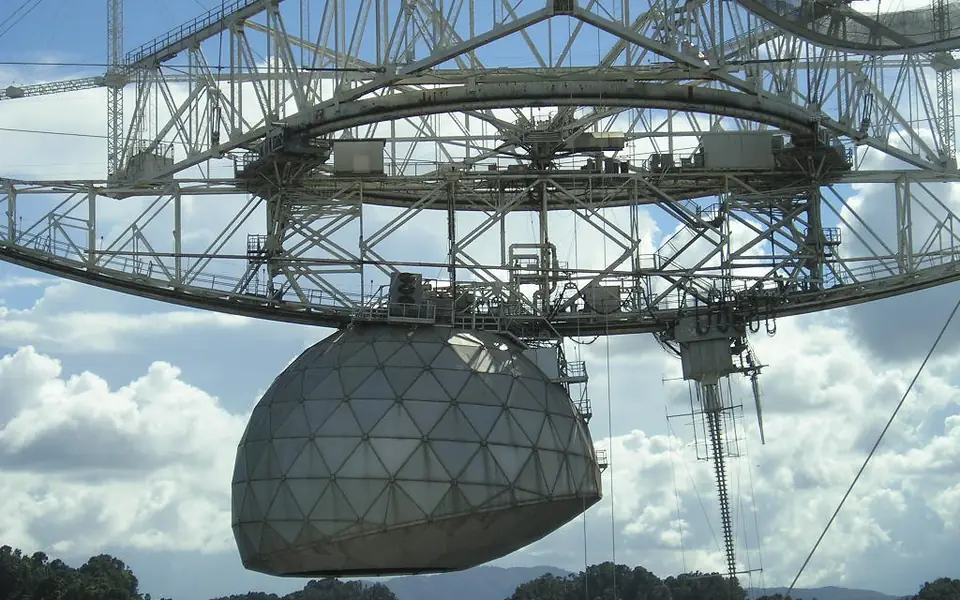
A greeting at a telescope ceremony
On November 16, 1974, people gathered at the Arecibo Observatory in Puerto Rico to celebrate an upgraded radio telescope. During the ceremony, a short transmission went into space while speakers turned its radio pattern into an audible warble for the audience. Some listeners left the tent and looked toward the instrument. The moment had two audiences: the people who could witness it immediately, and an imagined intelligence somewhere beyond Earth. The Arecibo message became famous as an interstellar greeting, although its practical purpose was to demonstrate what the powerful observatory could now do.
Arecibo had begun with questions closer to home. The telescope was conceived for radar studies of Earth's upper atmosphere, but it could also investigate planets and collect faint signals arriving from distant space. Its enormous reflector made a range of scientific work possible. Between 1972 and 1974, engineers resurfaced that reflector and installed another powerful transmitter, principally for planetary observations. Frank Drake recognized that the new equipment could also announce human technological capability. The message grew out of those improvements, rather than from the construction of a special machine devoted only to contacting extraterrestrials.
A picture hidden inside numbers
The design reduced a complicated introduction to 1,679 binary digits. That number was chosen because it is the product of two prime numbers, twenty-three and seventy-three. A receiver who suspected that the sequence encoded a picture might arrange the digits into a rectangle using those dimensions. In the intended arrangement, each row has twenty-three positions and there are seventy-three rows. Reading a one as a filled square and a zero as an empty square produces recognizable patterns. The mathematics supplied a possible clue to the arrangement, without requiring an English instruction sheet.
Once arranged, the picture presents numbers, chemicals associated with life, DNA, a human figure, a sketch of the Solar System, and the transmitting telescope. Drake developed the message with contributions from others, including Carl Sagan and Cornell graduate students. The familiar colored versions help modern viewers separate its sections, but the original radio signal carried no color information. Looking at those illustrations therefore requires an important distinction: the colors belong to an explanatory rendering made for human readers, while the actual transmission consisted of changes in radio frequency representing the binary sequence.
A powerful signal on a very long journey
The transmission was brief. At ten bits per second, the sequence took less than three minutes to send. Arecibo's large antenna concentrated a powerful transmitter's energy into a narrow direction instead of spreading it equally across the sky. The feat demonstrated engineering capability, but detection would still depend on circumstances at the receiving end. An observer would need suitable equipment, the right direction, and the opportunity to catch the passing signal. Sending a pattern once is very different from operating a persistent beacon that repeatedly offers an unknown listener a chance to notice it.
The selected direction pointed toward Messier 13, a globular star cluster in Hercules thousands of light-years away. Institutional accounts give approximate distances of around twenty-one to twenty-five thousand light-years, both emphasizing an immense travel time. The message cannot arrive there within a human lifetime, and a hypothetical reply would require another journey back. Stars also move, so the cluster's apparent position in 1974 should not be treated as a permanent destination label. No known recipient was waiting for the signal; the target gave the demonstration a direction, rather than establishing a conversation with an identified civilization.
Receiving a picture and understanding a sender
Turning bits into understanding presents another uncertainty. Even someone who reconstructed the rectangle would still have to interpret its shapes and relationships. A figure that looks human to us, or a pattern we associate with DNA, is recognizable partly because of knowledge we already possess. The University of Oregon's decoding exercise lets students try both rectangular arrangements, exposing how the picture depends on organization as well as content. It is a useful way to experience the problem directly: receiving information, arranging it correctly, and understanding what its sender meant are separate achievements.
The episode's historical importance does not depend on an extraterrestrial reply. Cornell's accounts describe it as a symbolic demonstration, while the SETI Institute points to the difficulties of communication across immense distances and unfamiliar cultures. The transmission continues outward; a few decades of travel remain tiny beside the distance to its intended direction. Meanwhile, its compact picture invites people on Earth to consider how they would describe their world without shared words. A ceremony lasting minutes produced a lasting question: which features of humanity would we choose to introduce, and what would another mind need in order to understand them?