Five days under an atmospheric lid
On December 5, 1952, London began disappearing behind an unusually thick mixture of smoke and fog. A city familiar with dim winter streets soon found ordinary journeys difficult to complete. By night, visibility in some places had fallen to only a few meters. The episode continued until December 9, but its consequences lasted far longer than the weather. The Great Smog became a disaster partly because a familiar inconvenience had concealed a danger: the atmosphere that hid buildings and stopped traffic also carried pollution into the lungs of the people beneath it.
The weather formed a lid over the city. Clear skies and light winds allowed the ground to cool, chilling moist air until water condensed into fog. A temperature inversion prevented the lower air from mixing freely with the atmosphere above it. Smoke accumulated beneath that stable layer instead of dispersing. The winter Sun could not readily clear the fog, and more emissions arrived while the polluted air remained trapped. The Met Office describes fog reaching roughly one hundred to two hundred meters deep, containing both water droplets and the products of countless chimneys.
Ordinary fuel and extraordinary disruption
Much of that smoke came from activities Londoners depended on. Coal fires warmed homes, factories required fuel, and power stations stood along the Thames. Cold weather encouraged people to keep their fires burning, while the city's economy continued producing emissions. Diesel buses added fumes after replacing the electric tram system. The disaster therefore grew out of an urban arrangement rather than one isolated machine breaking down. Sources of heat, employment, electricity, and transport each contributed to an atmosphere shared by everybody, making responsibility harder to locate than a single conspicuous accident.
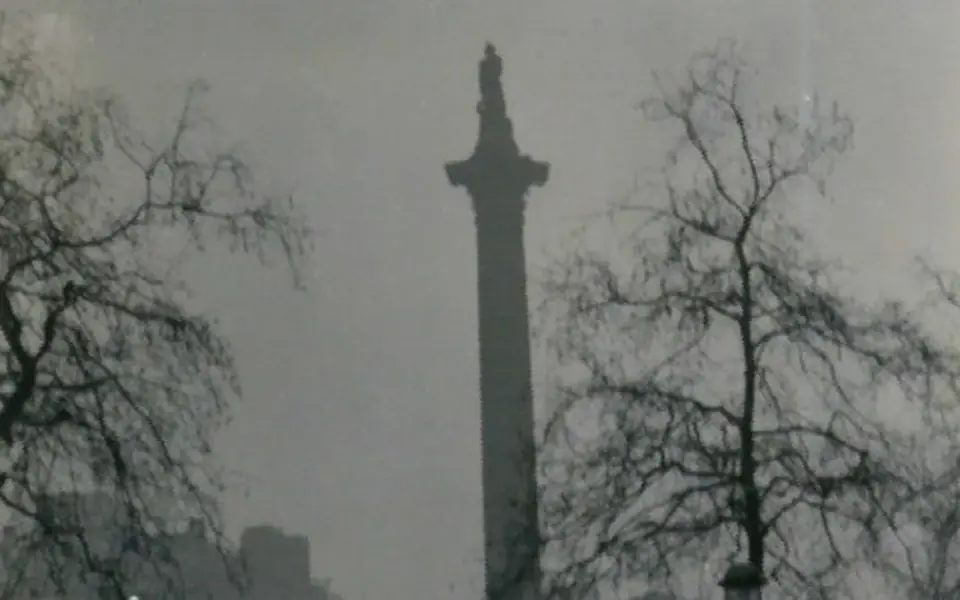
The disruption crossed the boundary between streets and interiors. London Museum records abandoned cars, canceled bus services, and smoke entering homes through small openings. Staying behind a closed door could not fully separate someone from the air outside. A photograph of Nelson's Column in December 1952 shows a famous landmark fading into a gray background; it gives visible form to the obscurity people experienced. Yet a photograph cannot show the whole disaster. Its most consequential evidence also lay in hospital admissions, illnesses, and deaths, recorded as the fog spread across the city.
Counting the deaths after the fog
Death totals require attention to the period being counted. Early assessments identified approximately four thousand excess deaths around the episode and its immediate aftermath. That figure describes deaths above the level normally expected, rather than four thousand people all dying at once in a street. In 2001, researchers Michelle Bell and Devra Davis reexamined mortality, hospital records, insurance claims, and other evidence. They estimated about twelve thousand excess deaths from December 1952 through February 1953. The larger number includes continuing effects after visibility improved; it should not be substituted for a five-day count without explanation.
The argument over the later deaths shows why a disaster's end can be difficult to date. Bell and Davis rejected the suggestion that influenza fully explained the elevated mortality in the following months. Their retrospective estimate depends on comparing observed deaths and other indicators with evidence from earlier periods. It does not identify every individual victim with certainty. For the historical reader, the distinction is useful: December 9 marks the clearing of the fog, while the records describe an aftermath extending beyond that date. Weather observations and mortality statistics answer related questions on different timescales.
From disaster to smoke control
Pressure for change eventually reached Parliament. The Beaver Committee investigated air pollution, and its recommendations helped shape the Clean Air Act of 1956. During the Lords debate, speakers recognized that legislation would require public cooperation and practical changes to homes and industry. Smoke control areas offered a way to regulate domestic burning as well as industrial emissions. Parliamentary records reveal the work hidden behind the familiar statement that a disaster produced a law: officials needed rules, local enforcement, suitable equipment, and public acceptance before a cleaner atmosphere could become an everyday condition.
Improvement came through implementation and further changes, including the Clean Air Act of 1968. Parliament's later review describes cleaner fuels, declining heavy industry, and changes in power generation as important parts of the wider reduction in smoke and sulphur dioxide. London had not solved every form of air pollution by making its old fogs less visible. The Great Smog remains a turning point because it connected household habits, atmospheric science, public records, and political decisions. A city discovered that the ordinary air between its buildings deserved the same serious attention as the buildings themselves.