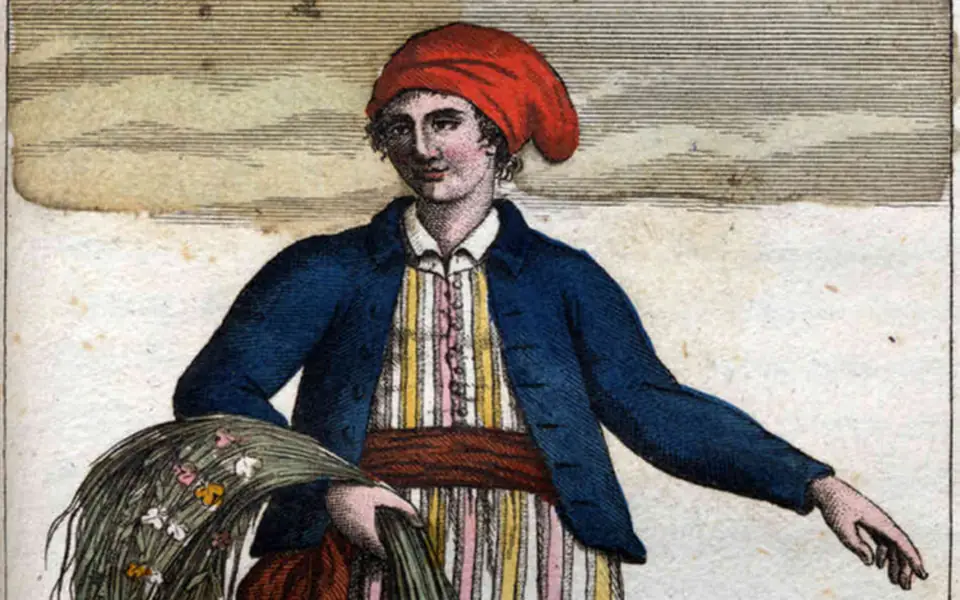
The work behind the disguise
Jeanne Baret's voyage around the world is often introduced through her disguise. She wore men's clothing and worked under a masculine identity to join a French naval expedition that excluded women. Yet a change of clothes did not explain how she could identify plants, carry equipment, or help build a scientific collection. Those skills belonged to a working woman whose contribution was difficult to see in the expedition's official credits. Looking past the disguise reveals a history of botanical labor, uneven recognition, and a life that continued long after the ships separated.
Born on July 27, 1740, Baret came from a poor family in Burgundy. The precise route by which she acquired her knowledge of plants remains uncertain. The Library of Congress warns that surviving documents support different interpretations of her early life and relationship with naturalist Philibert Commerson. It is tempting to turn every gap into a vivid scene, but there is no need to invent childhood lessons or private conversations. What can be established is that she became Commerson's domestic employee and assisted with botanical work before the expedition made her an ocean traveler.
A place aboard the Étoile
Louis-Antoine de Bougainville's expedition used two vessels, the Boudeuse and the Étoile, during its 1766–1769 circumnavigation. Baret and Commerson traveled aboard the Étoile. French naval rules barred women, so she entered as his male assistant, usually identified as Jean Baret. The arrangement gave her access to places from which her sex and social position would otherwise have excluded her. It also made ordinary shipboard life precarious. Her position depended on a role others would accept, while the scientific work still required her to go ashore and be seen.
Collecting a plant meant much more than noticing an attractive flower. At landfalls, the botanists gathered material and carried the equipment needed to preserve and compare it. Commerson's painful leg condition sometimes limited his movements, increasing the importance of his assistant's fieldwork. France's national natural history museum points out that specimens officially credited to Commerson cannot automatically be treated as his unaided work. This is a cautious attribution, rather than a claim that every surviving sheet was collected by Baret. The partnership's records show the difficulty of separating individual contributions after the fact.
A journey reconstructed from other voices
The journey took the expedition past South America and across the Pacific. Accounts of how Baret's identity became known disagree, and modern biographers have interpreted them differently. Tahiti is central to the best-known version, but it is unwise to narrate a single dramatic disclosure as if every detail were settled. Baret left no comprehensive personal account to balance the men's narratives. That absence matters: a story about her must often be assembled from what other people considered worth recording, including observations shaped by curiosity, hostility, or their own interests.
Baret and Commerson stayed on Mauritius when the expedition continued toward France, extending their botanical work in the Indian Ocean. Commerson died in 1773. Baret later married Jean Dubernat and returned to France, completing her journey around the globe; accounts commonly place that return in 1774 or 1775. This was a circumnavigation assembled in stages, rather than a single uninterrupted cruise with Bougainville. Her later life included property and business interests with her husband, and she eventually received a royal pension. The explorer was also a woman who made a practical life after exploration.
A name in the botanical record
A scientific name finally offered a different kind of recognition. In 2012, Eric Tepe, Glynis Ridley, and Lynn Bohs published Solanum baretiae, an Andean species named in her honor. Their paper described a plant from southern Ecuador and northern Peru and connected its naming to Baret's neglected botanical contribution. Commerson had earlier considered a genus bearing her name, but that proposal did not become an accepted published name. Naming the new species could not reconstruct every collection she made; it could place her firmly within the botanical record that had long obscured her.
Baret's achievement becomes richer when it is allowed to remain partly unresolved. Her disguise, fieldwork, time in Mauritius, later marriage, and botanical commemoration are different parts of the same life. They do not require a claim that she alone discovered every famous plant associated with the voyage, or that all historians agree about her private experiences. The strongest story rests on the evidence that survives and acknowledges the limits of that evidence. A woman crossed the world while helping collect its plants, and the names attached to those collections only partly reveal who did the work.