A discovery made in print
On August 25, 1835, New York readers opened The Sun to the beginning of an astonishing account of astronomical discovery. A six-part series claimed that the respected British astronomer John Herschel had observed an inhabited Moon. The report presented distant research as breaking news, connecting a familiar celestial object with an apparently authoritative scientific expedition. The discoveries were invented. Yet the Great Moon Hoax became more than a newspaper prank: it exposed how easily the appearance of scientific reporting could turn an imaginative story into something readers debated as evidence.
Herschel supplied the tale with a real foundation. He had traveled to the Cape of Good Hope to study the southern skies, so a report about observations from South Africa sounded possible. The imaginary apparatus then enlarged that foundation dramatically. The series described a telescope with an enormous lens and extraordinary powers, capable of revealing details far beyond ordinary observation. Distance protected the story from immediate checking. Readers in New York could encounter the name of a respected astronomer much faster than they could obtain a reliable answer from his observatory overseas.
Borrowed authority and lunar creatures
The articles attributed the observations to a supposed associate named Andrew Grant and invoked the Edinburgh Journal of Science as their source. These references made the narrative look as though it had passed through a chain of specialist witnesses and publications. In fact, Grant was fictional, and the scientific authority was borrowed. The presentation also advanced gradually, beginning with the expedition and instrument before offering remarkable discoveries. That sequence mattered: technical preparation encouraged readers to accept the observing method before they were asked to accept the increasingly fantastic things supposedly observed with it.
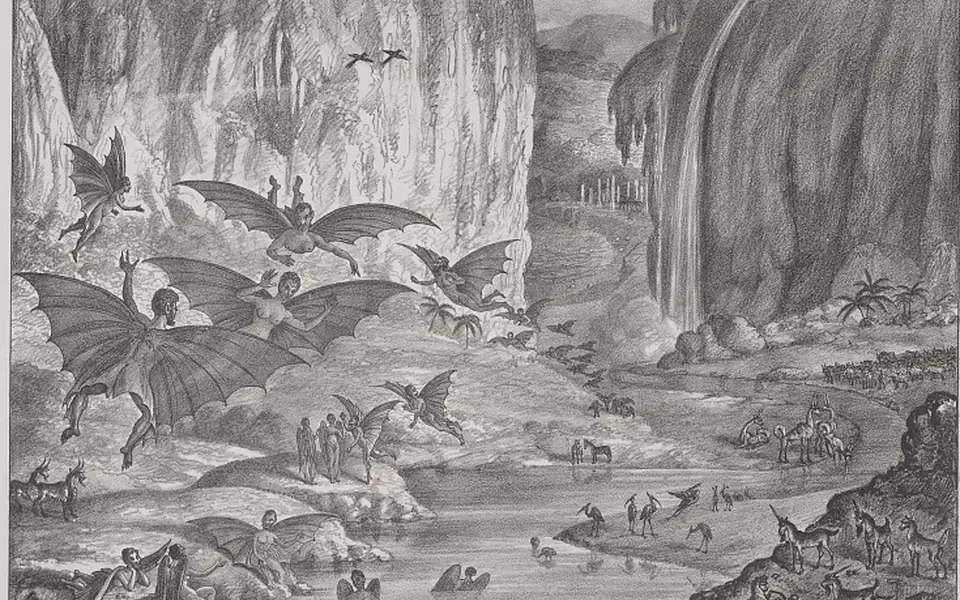
The lunar landscape became a busy world. The account described vegetation, unfamiliar animals, and creatures resembling earthly species with surprising alterations. Its most memorable inhabitants were humanlike beings with batlike wings. A surviving 1835 lithograph gathers such creatures into a rocky landscape, translating a textual claim into a scene a reader could inspect. The picture is evidence of what people printed and imagined, rather than evidence of lunar life. Its detailed scenery nevertheless supplied a visual form for the same illusion that the articles created through names, measurements, and confident descriptions.
Satire, belief, and illustrated editions
The story landed in an intellectual setting where inhabited worlds were already discussed seriously. Popular writers such as Thomas Dick joined astronomy with religious and philosophical speculation, presenting other worlds as possible homes for intelligent beings. Richard Adams Locke, the journalist generally associated with the series, maintained that satire was his aim. Understanding that claim does not require treating every contemporary reader as foolish. Scientific instruments were improving, expeditions were bringing unfamiliar observations home, and popular accounts often moved between evidence and speculation more freely than a modern reader might expect.
Print carried the imagined Moon beyond the original newspaper. Reprints and illustrated editions turned the story into material that could be bought, shared, and reconsidered elsewhere. Smithsonian Libraries preserves an Italian volume published in Naples in 1836, with hand-colored images associated with the fictional discoveries. Such objects show that the episode’s afterlife was not confined to a corrected news item. A spectacular tale can acquire commercial and artistic momentum even when its truth is disputed. Images and books allow an invented scene to survive independently of the confidence that first made it news.
The critics and the surviving evidence
Belief was never universal. Library of Congress research identifies competing newspapers challenging the reports during the original run, with several calling them a hoax by August 29. Some readers accepted the discoveries, others dismissed them, and still others followed the argument. The controversy could help the story travel: repeating a claim to reject it still brought that claim before another audience. The paper’s failure to plainly retract the series added a dispute about editorial responsibility. The history is therefore more complex than a simple account of an entire city being fooled at once.
Reading the Great Moon Hoax today works best as an exercise in tracing authority. A real scientist, a remote expedition, a technical instrument, and a supposed journal combined into a persuasive package, although the crucial observations were absent. Comparing the articles with contemporary criticisms and the surviving prints separates the event’s documented history from later legends about its reception. The most durable lesson concerns the path from assertion to confidence. Specific detail may make a story vivid, but reliable knowledge also requires identifiable evidence, independent checking, and a publisher willing to explain and correct what it has printed.