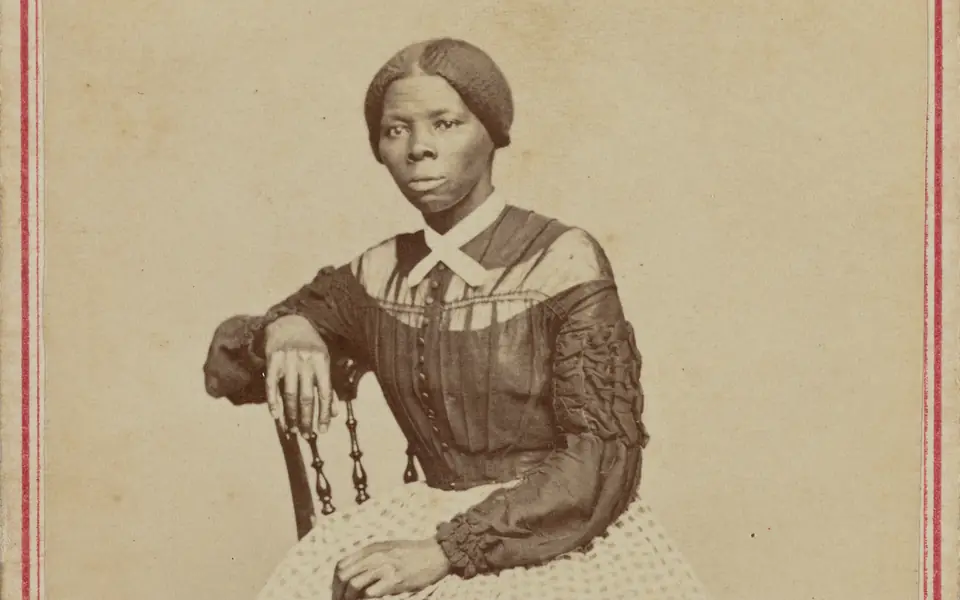
The landscape of slavery and escape
Harriet Tubman's famous journeys were rooted in a landscape she knew through work. Born Araminta Ross into slavery on Maryland's Eastern Shore around 1822, she grew up within a family and a network of people whose lives slavery continually threatened to divide. Labor in fields, woods and waterfront settings gave her experience of routes and surroundings. Those skills mattered when she escaped in 1849. Freedom began with her own decision and movement, but she could not separate her safety from the family and friends left behind.
She returned to Maryland repeatedly. National Park Service accounts place the number at about thirteen journeys, during which she guided roughly seventy people, many of them relatives and friends, toward freedom. She also advised others who traveled independently. These figures are smaller than the inflated totals repeated in some older biographies, yet they describe extraordinary sustained risk. Counting carefully makes the people involved more visible. Each journey required choices about timing, trust, concealment and separation, with severe consequences for anyone captured and for loved ones who remained enslaved.
Networks, law and family
The Underground Railroad was a metaphor for an escape network, rather than a physical railway carrying passengers north. Its conductors were guides; its stations were places where people might receive shelter and help. Tubman worked through relationships among free and enslaved African Americans and abolitionist supporters. Geography and personal trust belonged to the same system. Her success cannot be reduced to a mysterious signal or a single map. The National Park Service explicitly rejects the popular quilt-code story, which lacks the evidence needed to explain her actual methods.
Changes in law made freedom precarious even after a person reached a northern state. The Fugitive Slave Act of 1850 intensified the threat of capture and kidnapping. Canada therefore became an important destination, and Tubman spent time in St. Catharines, Ontario. Family freedom remained vulnerable too: she brought her elderly parents away from Maryland in 1857 after her father faced possible arrest for helping freedom seekers. The journeys were not simply departures from one place to another. They were attempts to create a more secure life where legal and personal dangers could reach across borders.
Knowledge in a wartime operation
During the Civil War, Tubman carried that experience into work for the Union. In South Carolina she served as a nurse and also as a scout and intelligence gatherer. Information came through people who understood the region, including informants and boat pilots. Their knowledge helped prepare a raid up the Combahee River with Colonel James Montgomery and the 2nd South Carolina Volunteers, a regiment of Black soldiers. In this setting, routes and local knowledge could support military movement as well as escape, connecting her earlier work to a much larger operation.
The expedition left on the evening of June 1, 1863, and reached its targets early on June 2. Union vessels and soldiers moved along the river, destroyed plantation property and enabled more than seven hundred enslaved people to leave. Tubman's role in planning and guiding the operation was crucial, but so was the action of those who fled toward the boats. They were making a rapid decision for themselves and their families under dangerous conditions. Some of the freed men subsequently joined Union forces, extending the raid's consequences beyond the riverbanks.
The work that continued after the war
After the war, Tubman's public commitments continued. She supported the movement for women's voting rights and maintained relationships with activists including Susan B. Anthony. In Auburn, New York, her home and the Home for the Aged became part of her humanitarian work. Family members joined her there, though slavery had permanently separated others. Her death in 1913 closed a long life of repeated service rather than a career defined by a single escape. The preserved Auburn sites help connect the celebrated guide to her later community and responsibilities.
Tubman's story gains depth when the people around her remain in view. She learned from a community, worked through networks, and helped others act on their own determination to be free. The Combahee raid dramatically increased the scale of that work, but it grew from skills developed over years. Accurate numbers and documented methods do not diminish her courage. They show more clearly what courage involved: returning to danger, sustaining trust, interpreting a landscape, and turning that knowledge into an opportunity that other people could use.