The historical setting
The Nok culture is a population whose material remains are named after the Ham village of Nok in southern Kaduna State of Nigeria, where their terracotta sculptures were first discovered in 1928. The Nok people and the Gajiganna people may have migrated from the Central Sahara, along with pearl millet and pottery, and diverged prior to arriving in the northern region of modern-day Nigeria. This may have led to their respective settlements in the regions of Gajiganna and Nok. Nok people may have also migrated from the West African Sahel to the region of Nok. Nok culture may have emerged in 1500 BCE and continued to persist until 1 BCE. Nok people may have developed terracotta sculptures, through large-scale economic production, as part of a complex funerary culture that may have included practices such as feasting.
Archaeology
The first Nok terracotta was discovered in 1928 by Colonel Dent Young, a co-owner of a mining partnership, near the village of Nok in Kaduna State, Nigeria. The terracotta was accidentally unearthed at a level of 24 feet (7 m) from an alluvial tin mine. Young presented the sculptures to the Museum of the Department of Mines in Jos. Preliminary excavations at the beginning of January 1961 began near a remote valley named Taruga near the village of Takushara. The trial excavations took place during a period of eight days. The finds included objects of wrought iron, a quantity of iron slag, fragments of tuyere, pottery, figurine fragments, red ocher, quartz hammer-stones, and small concentrations of charcoal.
The most famous finds at the site were the pottery graters which were shallow, flat-bottomed dishes which were deeply scored inside with diced patterns to produce a sharp abrasive surface. These pottery graters were probably used for food preparation. In the preliminary excavation a proton magnetometer survey was used to try and locate furnaces. The survey revealed a total of 61 magnetic anomalies which were mostly located in a flat, central area which probably indicated the limits of actual occupation.
Sculptures
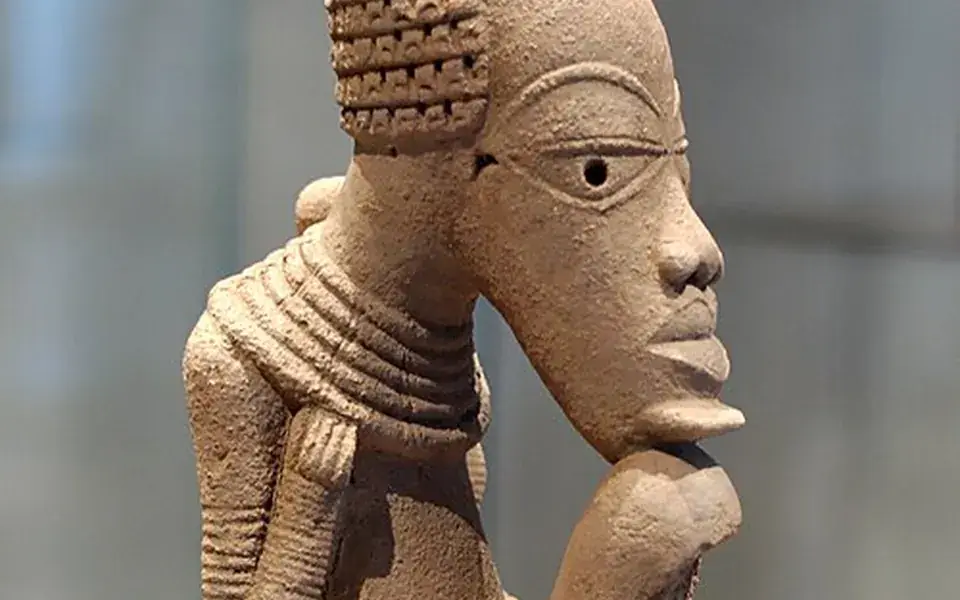
The terracotta figures are hollow, coil built, nearly life sized human heads and bodies that are depicted with highly stylized features, abundant jewelry, and varied postures. Because of the homogeneous composition of the sculptures across the Nok cultural, in contrast to the varying compositions of Nok pottery, it is thought that Nok sculpture was made from a few clay deposits, suggesting a centralized and specialized production. Little is known of the original function of the pieces, but theories include ancestor portrayal, grave markers, and charms to prevent crop failure, infertility, and illness. Also, based on the dome-shaped bases found on several figures, they could have been used as finials for the roofs of ancient structures.
As a result of natural erosion and deposition, Nok terracottas were scattered at various depths throughout the Sahel grasslands, causing difficulty in the dating and classification of the mysterious artifacts. Luckily, two archaeological sites, Samun Dukiya and Taruga, were found containing Nok art that had remained unmoved. Radiocarbon and thermo-luminescence tests dated the sculptures to a range of dates between about 2,900 and 2,000 years ago, making them some of the oldest in Western Africa.
Settlements and architecture
Akin to the peoples of the Chad Basin and Kintampo culture, the people of the Nok culture employed a mixed cropping method of cultivating cowpeas and pearl millet as well as utilized oleaginous fruits. At Pangwari, pearl millet was domesticated and cultivated, cowpeas were cultivated, and various forms of vegetation (e.g., Caesalpinioideae, Canarium schweinfurthii, Combretaceae, Phyllanthaceae, Vitex) were utilized. Hunting-gathering was another subsistence pattern followed by the Nok people. Nok peoples may have migrated into the central region of Nigeria and brought into the area the agricultural knowledge of cultivating tamed pearl millet between 1500 BCE and 900 BCE. At almost all Nok sites, there are charred plant remains consisting of firewood and plant material for cooking.
Remains of pearl millet, one of Africa's oldest grain crops, are commonly found. Pearl millet is highly productive and resistant to adverse growing conditions, including drought. Cowpeas, valued for their high protein content, are also found at some sites. So far, pearl millet and cowpeas are the only crops known to have been cultivated by the Nok people. It is unclear whether they ate or farmed tubers of any kind. The numerous grinding stones found at Nok sites suggest that the grains were ground into flour and made into a type of porridge.