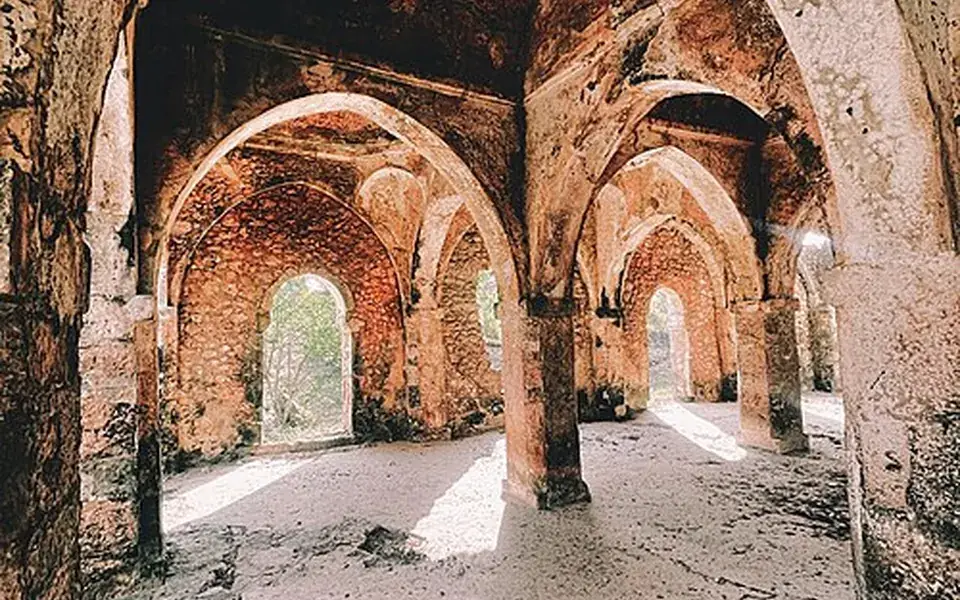
The historical setting
Kilwa Kisiwani ('Kilwa Island') is an island, national historic site, and hamlet community located in the township of Kilwa Masoko, the district seat of Kilwa District in the Tanzanian region of Lindi in southern Tanzania. Kilwa Kisiwani is the largest of the nine hamlets in the town of Kilwa Masoko and is also the least populated hamlet in the township with around 1,150 residents. Historically, it was the center of the Kilwa Sultanate, a medieval Swahili sultanate whose authority at its height in the 13th, 14th and 15th centuries stretched the entire length of the Swahili Coast. At its peak in the Middle Ages, Kilwa had over 10,000 inhabitants. Since 1981, the entire island of Kilwa Kisiwani has been designated by UNESCO as a World Heritage Site along with the nearby ruins of Songo Mnara.
Historical significance
Kilwa Kisiwani is a former Swahili City State site located along the Swahili Coast on the Kilwa Archipelago. Recent excavations and Carbon-14 dating of the site have confirmed its founding at the start of the 9th century CE. As in other areas of the East African coast, seasonal wind reversals (or monsoons) affected trade on the island. In 1331 CE, Moroccan traveller and scholar Ibn Battuta visited Kilwa and described it as one of the most beautiful cities in the world. Trade connections with the Arabian Peninsula as well as India and China influenced the growth and development of Kilwa, and though there are Islamic words and customs that have been adapted to the culture, its origins are African.
Many of the Swahili settlements showed complex layouts that reflected social relations between groups. However at Kilwa, there are many questions still left unanswered about the town's layout after the Portuguese Empire sacked and burnt it to the ground in July 1505. The Swahili cemeteries are located on the edge of the town, which is common for the Swahili region, and large, open spaces were likely used for social gatherings. An important city for trade, around the 13th century there were increased fortifications and a greater flow of goods.
Ceramics
At first, most of the focus was placed on the archaeology of Kilwa's ports and harbors, however, more and more emphasis is being placed on Kilwa's hinterlands. Ceramic artifacts are plentiful at the site and can be divided into two groups: regional and coastal. All of the ceramics with regional distribution were locally produced, but the area of distribution is limited. These unglazed ceramics were referred to as Kitchen Wares, though their uses were not necessarily just as cooking vessels. All of the varieties of locally produced pottery found in the region were also uncovered at the site of Kilwa itself. While the Kitchen Wares could be seen throughout the region, there were ceramics that were mostly seen within Kilwa itself.
These included modeled forms and red-burnished wares. The distribution pattern of the red-burnished wares was coastal. Other ceramic types that were seemingly restricted to town were the imported ceramic vessels from the Arabian peninsula and China. Imported ceramic materials are not found in rural areas. They were used as a sign of social status by the elite, kept in wall niches specifically crafted for their display. These imported ceramics played important symbolic roles along the Swahili Coast.
Palace of Husuni Kubwa
Husuni Kubwa (the "Great Palace"), situated outside the town, was an early 14th-century sultan's palace and emporium. Other defining features include causeways and platforms at the entrance of the harbour made from blocks of reef and coral nearly a meter high. These act as breakwaters, allowing mangroves to grow which is one of the ways the breakwater can be spotted from a distance. Some parts of the causeway are made from the bedrock, but usually the bedrock was used as a base. Coral stone was used to build up the causeways with sand and lime being used to cement the cobbles together. Some of the stones were left loose. The Palace of Husuni Kubwa is another prominent structure in Kilwa.
Most of the palace was erected in the 14th century by Sultan al-Hasan ibn Sulaiman of the Mahdali dynasty, who also built an extension to the nearby Great Mosque of Kilwa, although portions may date back to the 13th century. For unknown reasons, the palace was inhabited only for a brief period of time, and abandoned before its completion. In true Swahili architecture style the structure was built out of coral stone on a high bluff overlooking the Indian Ocean.