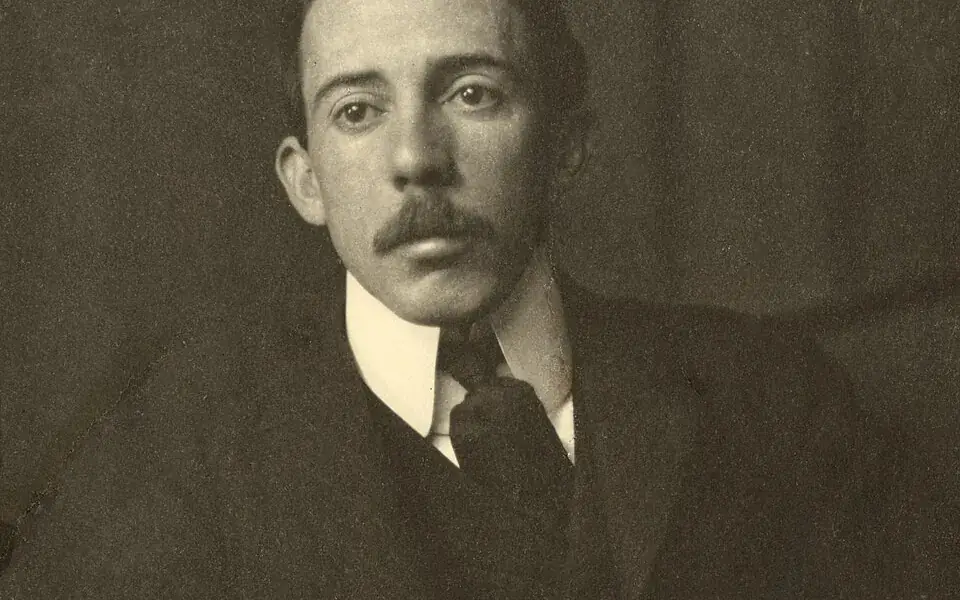
Alberto Santos-Dumont (20 July 1873 – 23 July 1932) was a Brazilian aeronaut, sportsman, inventor, and one of the few people to have contributed significantly to the early development of both lighter-than-air and heavier-than-air aircraft. The heir of a wealthy family of coffee producers, he dedicated himself to aeronautical study and experimentation in Paris, where he spent most of his adult life. He designed, built, and flew powered airships and won the Deutsch prize in 1901, when he flew around the Eiffel Tower in his airship No. 6, becoming one of the most famous people in the world in the early 20th century.
Balloons and controllable airships
In 1891, when he was 18, Santos-Dumont visited Europe. In England he spent a few months practising his English, and in France he climbed Mont Blanc. This adventure, at an altitude of almost 5,000 metres, gave him a taste for heights. The following year, his father had a serious accident, and released Alberto from parental care on 12 February 1892, advising him to focus on learning mechanics, chemistry, and electricity. Late nineteenth-century experimenters faced the challenge of controlling powered flight. Santos-Dumont’s work belonged to a wider history of attempts to combine lightweight envelopes, engines, and steering mechanisms in a practical airship.
The first airship designed by Santos-Dumont, the No. 1, was 25 metres long with a volume of 186 cubic metres, made its first takeoff attempt in February 1898, after being inflated in Henri Lachambre's workshops in Vaugirard. Snowy conditions caused the airship to flex and crash.
The challenge of heavier-than-air flight
In 1906 Santos-Dumont built a hybrid machine, the 14-bis or Oiseau de Proie, consolidating his studies of what had been done in aviation until then, without having had experience with gliders. By mid-year, within two months of starting, he completed an aeroplane attached to a hydrogen balloon to assist takeoff. On 18 July, after completing the 14-bis, Santos-Dumont signed up for a competition and presented the aircraft for the first time the next day at Bagatelle, achieving some short hops.
Santos-Dumont decided not to compete for the prizes with the hybrid, but on 20 July signed up for the tests and over the next three days continued to test the plane tethered to the balloon, to practise steering. Throughout the tests he realised that, although the balloon helped take-off, it made flight difficult as the drag generated was too great. The airship was discarded, and the biplane received the name Oiseau de Proie ("Bird of Prey") from the press.
On 23 October, Santos-Dumont presented himself at Bagatelle with the Oiseau de Proie II, a modification of the original model. The plane had been varnished to reduce the porosity of the fabric and increase lift. The rear wheel had been removed. In the morning he limited himself to manoeuvring the aircraft across the field, until the propeller shaft broke. It was repaired in the afternoon, and the plane was moved into position for an official attempt.
New aircraft and lighter machines
Santos-Dumont also made the No. 15, a biplane with a rear-mounted rudder, as opposed to the canard format, the No. 16, a mix of airship and aeroplane, No. 17 and No. 18, a waterslide used to test the wing shape underwater. Dissatisfied with numbers 15 to 18, he made a new series, smaller in size and more refined, like the Demoiselle, that was capable of reaching up to 90 kilometres per hour. It was first tested in November 1907, returning on an abandoned idea from 1905, but soon realised that it "... had serious structural problems" according to Henrique Lins de Barros.
However, on November 17, 1907, he competed for the Deutsch-Archdeacon award, crossing 200 meters at a height of 6 meters, but abandoning before the required 1000 meters due to a breakdown in the aircraft. In 1909 he presented the Demoiselle No. 20, improved and considered "the first ultralight in history". This aeroplane was designed for sports competitions and 300 were built in several European countries and in the United States. His schemes were published in the June–July 1910 issues of Popular Mechanics. This plane consolidated Santos-Dumont's role in the birth of aviation in the 20th century.