The Moche civilization (alternatively, the Moche culture or the Early, Pre- or Proto-Chimú) flourished in northern Peru from about 100 to 800 AD, during the Regional Development Epoch. The capital of a Southern Moche polity was near present-day Moche, Trujillo, Peru, with several other, possibly independent, regions under Moche influence. Many scholars contend that the Moche were not politically organized as a monolithic empire or state. Rather, they were likely a group of autonomous polities that shared a common culture, as seen in the rich iconography and monumental architecture that survives today.
Communities of the northern coast
Moche society was agriculturally based, with a significant level of investment in the construction of a sophisticated network of irrigation canals for the diversion of river water to supply their crops. Their artifacts express their lives, with detailed scenes of hunting, fishing, fighting, sacrifice, sexual encounters, and elaborate ceremonies. Moche ceremonies were commonly associated with movement, but "stasis" and standing still were also very significant. These pauses were shown in "liminal spaces", which were in-between spaces like sunken steps or ramps.
The Moche are particularly noted for their elaborately painted ceramics, gold work, monumental constructions (huacas), and irrigation systems. Moche history may be broadly divided into three periods: the emergence of the Moche culture in Early Moche (100–300 AD), the expansion and flourishing during Middle Moche (300–600 AD), and the urban nucleation and subsequent collapse in Late Moche (500–800 AD).
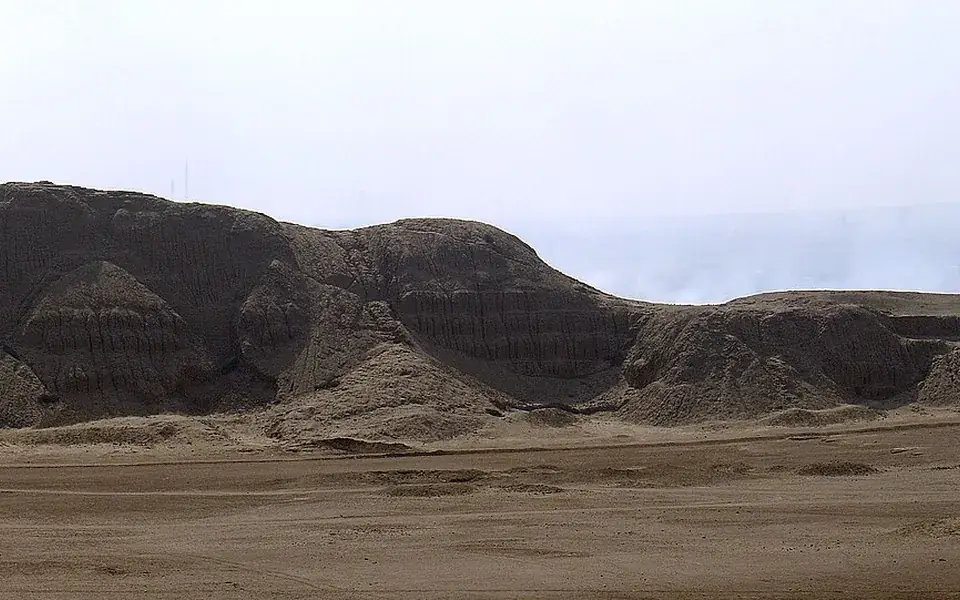
The Moche cultural sphere is centered on several valleys on the north coast of Peru in the regions of La Libertad, Lambayeque, Jequetepeque, Chicama, Moche, Virú, Chao, Santa, and Nepena. It occupied 250 miles of desert coastline and up to 50 miles inland. The Huaca del Sol, a pyramidal adobe structure on the Rio Moche, was the largest pre-Columbian structure in Peru. It was partly destroyed when Spanish Conquistadors looted its graves for gold in the 16th century.
Art in clay and metal
Moche pottery is some of the most varied in the world. Pottery has been the distinguishing feature of the Moche culture for many reasons. It is known for being highly decorated and standardized and led people to believe the Moche had been part of a corporate state system. The use of mold technology is evident, which would have enabled the mass production of certain forms. But Moche ceramics vary widely in shape and theme, with most important social activities documented in pottery, including war, agriculture, metalwork, weaving, and erotica.
Specifically, the architectural vessels, which are pots that resemble buildings. They also include elites and warriors. Traditional north coast Peruvian ceramic art uses a limited palette, relying primarily on red and white colors, fineline painting, fully modeled clay, veristic figures, and stirrup spouts. The Moche discovered both electrochemical replacement plating and depletion gilding, which they used to cover copper crafts found at Loma Negra in thin layers of gold or silver.
Modern attempts were able to recreate a similar chemical plating process using boiling water and salts found naturally in the area. It is the Moche ceramic tradition that had previously been given the most attention in Archaeology, though this is beginning to change as archaeologists continue to discover ties between iconography on ceramic and other parts of Moche art. Just as important to Moche craftsmanship and culture is metallurgy.
Irrigation, ritual, and social order
Researchers of the Moche culture agree that the emergence of the Moche culture is related to the intensification of the production of corn, cotton, beans and squash, among other agricultural products, which allowed the development of a regional Moche political economy in the Valley of Moche from the north coast of Peru during the Early Intermediate Period (400 BC–600 AD). The northern region of Peru is one of the most arid areas in the world, where there is no rain throughout the year.
Both iconography and the finds of human skeletons in ritual contexts seem to indicate that human sacrifice played a significant part in Moche religious practices. In some sacrifice scenes on ceramics, there is a mythical creature called the animal lunar/moon animal, which is placed above a prisoner's head. This shows the significance of human sacrifice. When the artist places the creature there, the viewer can assume the prisoner's fate. These rites appear to have involved the elite as key actors in a spectacle of costumed participants, monumental settings and possibly the ritual consumption of blood.
Although it remains somewhat unclear how geographically divided Moche culture was, scholars are very confident that the Moche were a socially divided society. Beyond royalty, the Moche can be divided into a general upper and lower class, and each class can be further stratified into smaller groups. Intra-class movement was possible within these broad categories, but inter-class switches between them were less feasible.