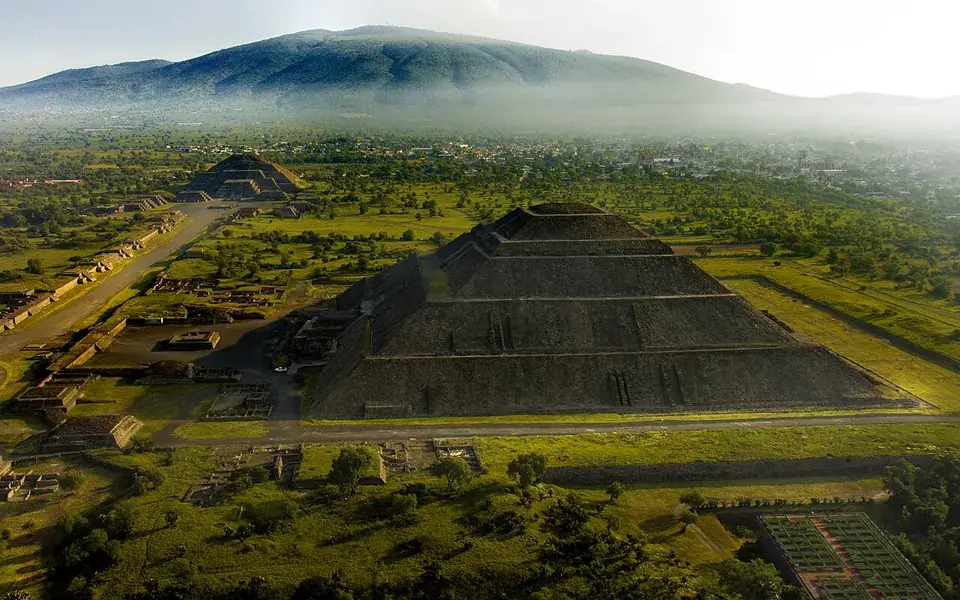
Teotihuacan (Spanish: Teotihuacán,; Classical Nahuatl: Teōtīhuacān,) is an ancient Mesoamerican city located in a sub-valley of the Valley of Mexico, which is located in the State of Mexico, 40 kilometers (25 mi) northeast of modern-day Mexico City. Teotihuacan is known today as the site of many of the most architecturally significant Mesoamerican pyramids built in the pre-Columbian Americas, namely the Pyramid of the Sun and the Pyramid of the Moon.
Founding and growth
The early history of Teotihuacan is quite mysterious, and the origin of its founders is uncertain. Around 300 BCE, people of the central and southeastern areas of Mesoamerica began to gather into larger settlements. Teotihuacan was the largest urban center of Mesoamerica before the Aztecs, almost 1000 years prior to their epoch. The city was already in ruins by the time of the Aztecs. For many years, archeologists believed it was built by the Toltec. This belief was based on colonial period texts, such as the Florentine Codex, which attributed the site to the Toltecs.
However, the Nahuatl word "Toltec" generally means "craftsman of the highest level" and may not always refer to the Toltec civilization centered at Tula, Hidalgo. Since Toltec civilization flourished centuries after Teotihuacan, the people could not have been the city's founders. In the Late Formative era, a number of urban centers arose in central Mexico. The most prominent of these appears to have been Cuicuilco, on the southern shore of Lake Texcoco.
Scholars have speculated that the eruption of the Xitle volcano may have prompted a mass emigration out of the central valley and into the Teotihuacan valley. These settlers may have founded or accelerated the growth of Teotihuacan. Other scholars have put forth the Totonac people as the founders of Teotihuacan and have suggested that Teotihuacan was a multi-ethnic state since they find diverse cultural aspects connected to the Zapotec, Mixtec, and Maya peoples.
Life in a cosmopolitan metropolis
Teotihuacan had one of the largest, or perhaps had the largest, population of any city in the Basin of Mexico during its occupation. Teotihuacan was a large pre-historic city that underwent massive population growth and sustained it over most of the city's occupancy. In 100 CE, the population could be estimated at around 60,000–80,000, after 200 years of the city's occupancy, within 20 km of the city. The population, eventually, stabilized around 100,000 people around 300 CE.
The processing of obsidian was the most developed art and the main source of wealth in Teotihuacan and many other ancient Mesoamerican cultures. The workshops produced tools or objects of obsidian of various uses and types (black and grey colors), intended for commercial transactions beyond the geographical boundaries of the city, with cities such as Monte Alban in Oaxaca Mexico, Tikal in Guatemala, and some Mayan states. Figurines, blades, arrowheads, spikes, knife handles, jewelry, masks, or ornaments, etc were some of the most notable and common objects constructed.
The consensus among scholars is that the primary deity of Teotihuacan was the Great Goddess of Teotihuacan. The dominant civic architecture is the pyramid. Politics were based on the state religion, and religious leaders were the political leaders. Religious leaders would commission artists to create religious artworks for ceremonies and rituals. The artwork likely commissioned would have been a mural or a censer depicting gods like the Great Goddess of Teotihuacan or the Feathered Serpent.
Monuments and decline
The city's broad central avenue, called "Avenue of the Dead" (a translation from its Nahuatl name Miccaotli), is flanked by impressive ceremonial architecture, including the immense Pyramid of the Sun (third largest in the world after the Great Pyramid of Cholula and the Great Pyramid of Giza). Pyramid of the Moon and The Ciudadela with Temple of the Feathered Serpent are placed at both ends of the Avenue while Palace-museum Quetzalpapálot, the fourth basic structure of the site, is situated between two main pyramids. The city reached its peak in 450 CE when it was the center of a powerful culture whose influence extended through much of the Mesoamerican region.
At this time, the city covered over 30 km (over 11+1⁄2 square miles), and perhaps housed a population of 150,000 people, with one estimate reaching as high as 250,000. Although, more recent residential structure analysis by Smith supports a population estimate of around 100,000 people. Various districts in the city housed people from across the Teotihuacan region of influence, which spread south as far as Guatemala. Scholars originally thought that invaders attacked the city in the 7th or 8th century, sacking and burning it. More recent evidence, however, seems to indicate that the burning was limited to the structures and dwellings associated primarily with the ruling class.