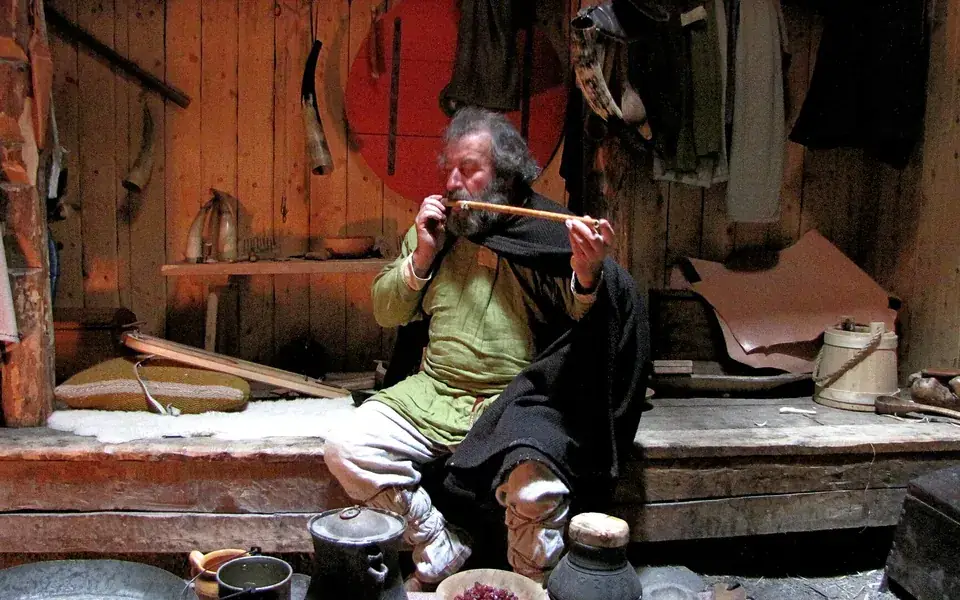
L'Anse aux Meadows is an archaeological site, first excavated in the 1960s, of a Norse settlement dating to approximately 1,000 years ago. The site is located near St. Anthony on the northernmost tip of the island of Newfoundland in the Canadian province of Newfoundland and Labrador. With carbon dating estimates between 990 and 1050 CE (mean date 1014) and tree-ring dating of 1021, L'Anse aux Meadows is the only undisputed site of pre-Columbian trans-oceanic contact of Europeans with the Americas outside of Greenland.
A place already inhabited
Indigenous people used the site of L'Anse aux Meadows over a span of thousands of years, beginning roughly 6,000 years ago. Archaeologists have identified traces of several distinct groups, with occupations both before and after the Norse visit. These date ranges do not place an Indigenous settlement at the site during the Norse occupation itself. A prominent earlier occupation belonged to the Dorset people, whose camps stood on the southern shore of the bay more than two centuries before the Norse.
Radiocarbon date ranges for these groups are c. 4000 – c. 1000 BCE for the Maritime Archaic tradition, c. 1000 – c. 500 BCE for the Groswater tradition, c. 400 – c. 750 for the Middle Dorset, c. 800 – c. 850 for the Cow Head Group and Beaches traditions, and c. 1200 – c. 1500 CE (after the Norse) for the Little Passage tradition.
Norse buildings and voyages
The Norse settlement at L'Anse aux Meadows has been dated to approximately 1000 CE (carbon dating estimates 990–1050, with a mean carbon date of 1014), an assessment that tallies with the relative dating of artifact and structure types. A 2021 Nature study, using radiocarbon analysis of three separate tree ring samples and evidence from the anomaly in atmospheric C concentrations in the year 993, pinpointed 1021 as a date of Norse activity at L'Anse aux Meadows. Anthropologist John Steinberg has suggested the site may have been "occupied at least sporadically for perhaps 20 years" by the Norse. Eleanor Barraclough suggests the site was not a permanent settlement but a temporary boat repair facility. She notes there are no findings of burials, agriculture or animal pens—suggesting the inhabitants abandoned the site in an orderly fashion.
According to a 2019 Proceedings of the National Academy of Sciences of the United States of America study, there may have been Norse activity in L'Anse aux Meadows for as long as a century. There is no way to know the site's population at any given time, though the dwellings could accommodate 30 to 160 people. The entire population of Greenland at the time was about 2,500, meaning that the L'Anse aux Meadows site harbored far fewer than 10 percent of the number living at the Norse settlements on Greenland.
Archaeology and the sagas
Archaeological remains of Norse buildings were discovered at L'Anse aux Meadows by the Norwegian husband-wife team of explorer Helge Ingstad and archaeologist Anne Stine Ingstad, who led an international team excavating during 1961–1968. Based on the idea that the Old Norse name Vinland in the Icelandic Sagas meant "wine-land", historians had long speculated that the Norse had landed in a region with wild grapes. The common hypothesis before the Ingstads was that Vinland could not be north of the Massachusetts coast, the northern limit of wild grapes, though they are also found in New Brunswick and the St. Lawrence River valley. The Ingstads doubted this hypothesis, believing the Norse would not have felt secure settling along the American Atlantic coast.
In the eleventh century, the German cleric Adam of Bremen included Vinland in his history of the archbishops of Hamburg-Bremen, who held ecclesiastical authority over Norse Scandinavia. Adam attributed his information to Danish reports. He described a land where vines and grain grew without cultivation; this is an account of what he had been told, rather than an archaeological observation or a record of his own voyage. Two traditional Icelandic sagas, the Saga of the Greenlanders and the Saga of Erik the Red, also tell of Norse Greenlanders who discovered and attempted to settle a western land called Vinland. The written traditions and the excavated settlement offer different kinds of evidence for those Atlantic journeys.