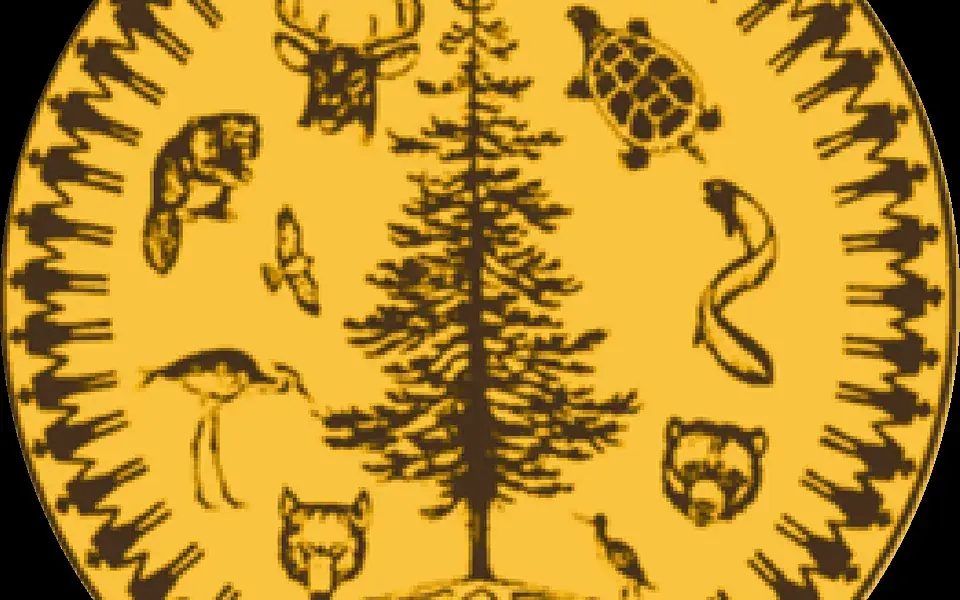
The Haudenosaunee Confederacy, also known as the Iroquois, is a confederacy of Iroquoian-speaking indigenous peoples in northeast North America. They were known by the French during the colonial years as the Iroquois League, and later as the Iroquois Confederacy. They have also been called the Six Nations (Five Nations before 1722).
The formation of a league
The Haudenosaunee League was established prior to European contact, with the banding together of five Iroquoian peoples living south of the Great Lakes into "The Great League of Peace". Many archaeologists and anthropologists believe that the League was formed about 1450, though arguments have been made for dates as early as the solar eclipse of August 31, 1142. The founders of the League are traditionally held to be Dekanawida the Great Peacemaker, Hiawatha, and Jigonhsasee the Mother of Nations, whose home acted as a sort of United Nations.
The traditional founders brought the Peacemaker's Great Law of Peace to the five Iroquoian nations who were fighting, raiding, and feuding with each other and with other tribes, both Algonkian and Iroquoian. From east to west, the League was composed of the Mohawk, Oneida, Onondaga, Cayuga, and Seneca nations. Each nation involved had a distinct Iroquoian language, territory, and function in the League. The League itself is embodied in its Grand Council, an assembly of fifty chiefs, each representing a clan of a nation.
There were many other independent Iroquoian-speaking peoples outside the Haudenosaunee League. The Erie, Susquehannock, and Wendat (Huron) lived at various times along the St. Lawrence River and around the Great Lakes, often competing and warring with neighboring nations of the League. In the American Southeast, the Cherokee were another Iroquoian-language people who had migrated to that area centuries before European contact.
Authority and the roles of women
Haudenosaunee kinship is matrilineal, and hereditary leadership passes through the female line of descent, that is, from a mother to her children. The children of a traditional marriage belong to their mother's clan and gain their social status through hers. Her brothers are important teachers and mentors to the children, especially introducing boys to men's roles and societies. If a couple separates, the woman traditionally keeps the children. It is regarded as incest by the Haudenosaunee to marry within one's matrilineal clan, but considered acceptable to marry someone from the same patrilineal clan.
The teachings of Handsome Lake also expanded to influence the wider Haudenosaunee society. The power centered around the mode of food production and the social sphere in general. The Grand Council of the Six Nations is an assembly of 56 Hoyenah (chiefs). Chief offices are hereditary within their clan. When a position becomes vacant a candidate is selected from among the members of the clan and "raised up" by a council of all chiefs. The new chief gives up his old name and is thereafter addressed by the title.
When anthropologist Lewis Henry Morgan studied the Grand Council in the 19th century, he interpreted it as a central government. This interpretation became influential, but Richter argues that while the Grand Council served an important ceremonial role, it was not a government in the sense that Morgan thought. According to this view, Haudenosaunee political and diplomatic decisions are made on the local level and are based on assessments of community consensus.
Wampum and collective memory
The term "wampum" refers to beads made from purple and white mollusk shells on threads of elm bark. Species used to make wampum include the highly prized quahog clam which produces the famous purple colored beads. For white colored beads the shells from the channeled whelk, knobbed whelk, lightning whelk, and snow whelk are used. Wampum was primarily used to make wampum belts by the Haudenosaunee, which Haudenosaunee tradition claims was invented by Hiawatha to console chiefs and clan mothers who lost family members to war.
Wampum belts played a major role in the Condolence Ceremony and in the raising of new chiefs. Both chiefs and clan mothers wear wampum belts as symbol of their offices. Within each of the Six Nations, people belonged to a number of matrilineal clans. The number of clans varies by nation, currently from three to eight, with a total of nine different clan names.