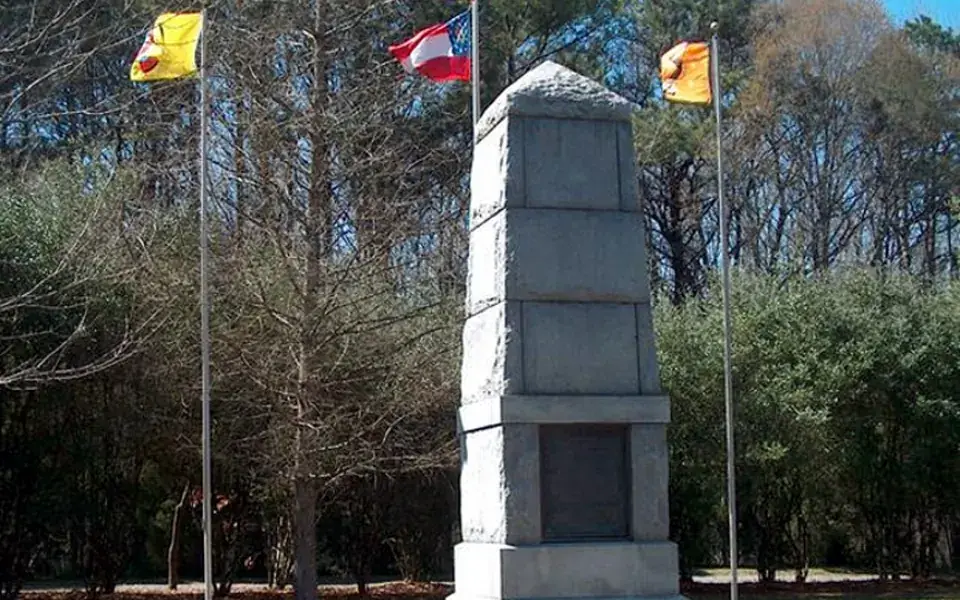
The Trail of Tears was the forced displacement and ethnic cleansing of about 60,000 Native Americans of the "Five Civilized Tribes", including their black slaves, between 1830 and 1850 by the United States government. As part of Indian removal, members of the Cherokee, Muscogee, Seminole, Chickasaw, and Choctaw nations were forcibly removed from their ancestral homelands in the Southeastern United States to newly designated Indian Territory west of the Mississippi River after the passage of the Indian Removal Act in 1830.
Removal becomes federal policy
Before 1838, the fixed boundaries of these autonomous Indian nations, comprising large areas of the United States, were subject to continual cession and annexation, in part due to pressure from squatters and the threat of military force in the newly declared U.S. territories—federally administered regions whose boundaries supervened upon the Indian treaty claims. As these territories became U.S. states, state governments sought to dissolve the boundaries of the Indian nations within their borders, which were independent of state jurisdiction, and to expropriate the land therein. These pressures were exacerbated by U.S. population growth and the expansion of slavery in the South, with the rapid development of cotton cultivation in the uplands after the invention of the cotton gin by Eli Whitney.
Although Jackson was not the sole, or original, architect of Removal policy, his contributions were influential in its trajectory. Jackson's support for the removal of the Indians began at least a decade before his presidency. Indian removal was Jackson's top legislative priority upon taking office. In his first address to Congress, Jackson described emigration as voluntary but also insisted that Native people remaining within states would have to submit to state laws. That combination of language helped disguise the coercive pressures surrounding removal.
A disputed treaty and legal resistance
Jackson chose to continue with Indian removal, and negotiated the Treaty of New Echota, on December 29, 1835, which granted the Cherokee two years to move to Indian Territory (modern-day Oklahoma). The Chickasaws and Choctaws had readily accepted and signed treaties with the U.S. government, while the Creeks did so under coercion. The negotiation of the Treaty of New Echota was largely encouraged by Jackson, and it was signed by a minority Cherokee political faction, the Treaty Party, led by Cherokee leader Elias Boudinot. However, the treaty was opposed by most of the Cherokee people, as it was not approved by the Cherokee National Council, and it was not signed by Principal Chief John Ross.
The establishment of the Indian Territory and the extinguishing of Indian land claims east of the Mississippi by the Indian Removal Act anticipated the U.S. Indian reservation system, which was imposed on remaining Indian lands later in the 19th century. The statutory argument for Indian sovereignty persisted until the U.S. Supreme Court ruled in Cherokee Nation v. Georgia (1831), that the Cherokee were not a sovereign and independent nation, and therefore not entitled to a hearing before the court. In the years after the Indian Removal Act, the Cherokee filed several lawsuits regarding conflicts with the state of Georgia. Some of these cases reached the Supreme Court, with Worcester v.
The Cherokee journey west
By 1838, about 2,000 Cherokee had voluntarily relocated from Georgia to Indian Territory, in present-day Oklahoma. Forced removals began in May, after General Winfield Scott received an order from President Martin Van Buren to remove those who remained. Scott instructed troops to avoid cruelty during the operation, but the government still compelled people to leave their homes. The policy followed the Indian Removal Act and a treaty that the elected Cherokee leadership and much of the population had rejected.
Thousands of Cherokee died during removal and the journey west; an often-cited estimate places the toll at about 4,000. Disease, inadequate food, exposure, and the conditions of detention and travel contributed to the disaster. Cherokee names for the event convey the memory of a place or trail where people cried, connecting the historical journey with a continuing account of collective loss.