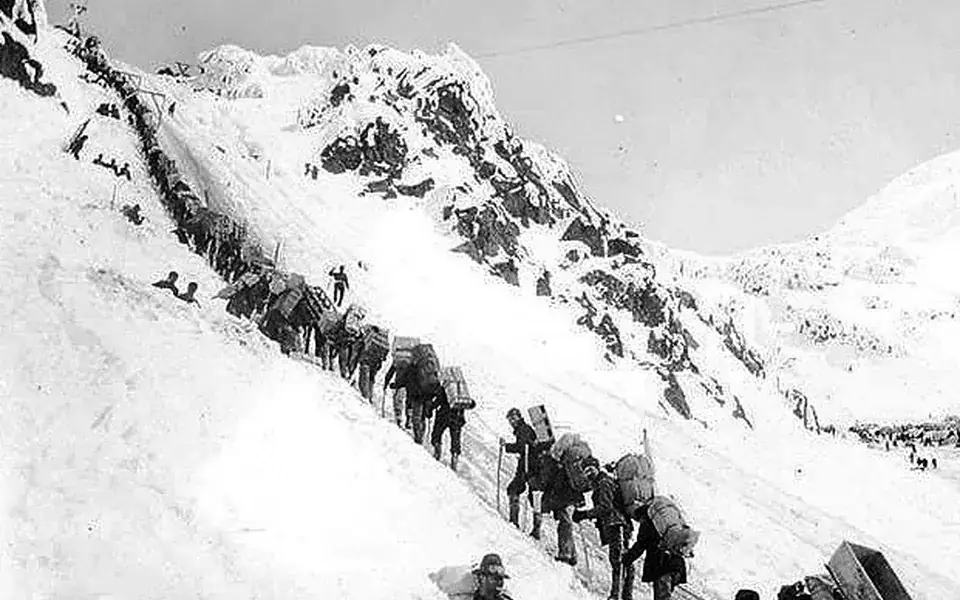
The Klondike Gold Rush was a migration by an estimated 100,000 prospectors to the Klondike region of Yukon in northwestern Canada, between 1896 and 1898. Gold was discovered there by local miners on August 16, 1896; when news reached Seattle and San Francisco the following year, it triggered a stampede of prospectors. Some became wealthy, but the majority went in vain. It has been immortalized in films, literature, and photographs.
Gold brings a stampede
On August 16, 1896, an American prospector named George Carmack and two Tagish men, Skookum Jim (Keish), and Tagish Charlie (K̲áa Goox̱) were travelling south of the Klondike River. Following a suggestion from Robert Henderson, a Canadian prospector, they began looking for gold on Bonanza Creek, then called Rabbit Creek, one of the Klondike's tributaries. It is not clear who discovered the gold: George Carmack or Skookum Jim, but the group agreed to let George Carmack appear as the official discoverer because they feared that authorities would not recognize an indigenous claimant.
In any event, gold was present along the river in huge quantities. Carmack measured out four strips of ground for mining along the river, two for himself as the discoverer and one each for Jim and Charlie. In the resulting Klondike stampede, an estimated 100,000 people tried to reach the Klondike goldfields, though only around 30,000 to 40,000 eventually did. The height of the Klondike gold rush was from the summer of 1897 to the summer of 1898.
The stampede of prospectors began on July 14, 1897, in San Francisco and was spurred further three days later in Seattle, when the first of the early prospectors returned from the Klondike, bringing with them large amounts of gold on the ships Excelsior and Portland. The press reported that a total of $1,139,000 had been brought in by these ships, although this proved to be an underestimate. The migration of prospectors caught so much attention that it was joined by outfitters, writers and photographers.
The difficult road north
Those who landed at Skagway made their way over the White Pass before cutting across to Bennett Lake. Although the trail began gently, it progressed over several mountains with paths as narrow as 2 feet (0.61 m) and in wider parts covered with boulders and sharp rocks. Under these conditions horses died in huge numbers, giving the route the informal name of Dead Horse Trail. The volumes of travellers and the wet weather made the trail impassable and, by late 1897, it was closed until further notice, leaving around 5,000 stranded in Skagway.
Those who landed at Dyea, Skagway's neighbour town, travelled the Chilkoot Trail and crossed its pass to reach Lake Lindeman, which fed into Lake Bennett at the head of the Yukon River. The Chilkoot Pass was higher than the White Pass, but more used it: around 22,000 during the gold rush. The trail passed up through camps until it reached a flat ledge, just before the main ascent, which was too steep for animals. The borders in South-east Alaska were disputed between the US, Canada and Britain since the American purchase of Alaska from Russia in 1867. The US and Canada both claimed the ports of Dyea and Skagway.
This, combined with the numbers of American prospectors, the quantities of gold being mined and the difficulties in exercising government authority in such a remote area, made the control of the borders a sensitive issue. Early on in the gold rush, the US Army sent a small detachment to Circle City, in case intervention was required in the Klondike, while the Canadian government considered excluding all American prospectors from the Yukon Territory.
Life and work in the goldfields
Mining began with clearing the ground of vegetation and debris. Prospect holes were then dug in an attempt to find the ore or "pay streak". If these holes looked productive, proper digging could commence, aiming down to the bedrock, where the majority of the gold was found. The digging would be carefully monitored in case the operation needed to be shifted to allow for changes in the flow. In the sub-Arctic climate of the Klondike, a layer of hard permafrost lay only 6 feet (1.8 m) below the surface. Traditionally, this had meant that mining in the region only occurred during the summer months, but the pressure of the gold rush made such a delay unacceptable.
The remoteness of Dawson proved an ongoing problem for the supply of food, and as the population grew to 5,000 in 1897, this became critical. When the rivers iced over, it became clear that there would not be enough food for that winter. The NWMP evacuated some prospectors without supplies to Fort Yukon in Alaska from September 30, 1897 onwards, while others made their way out of the Klondike in search of food and shelter for the winter.