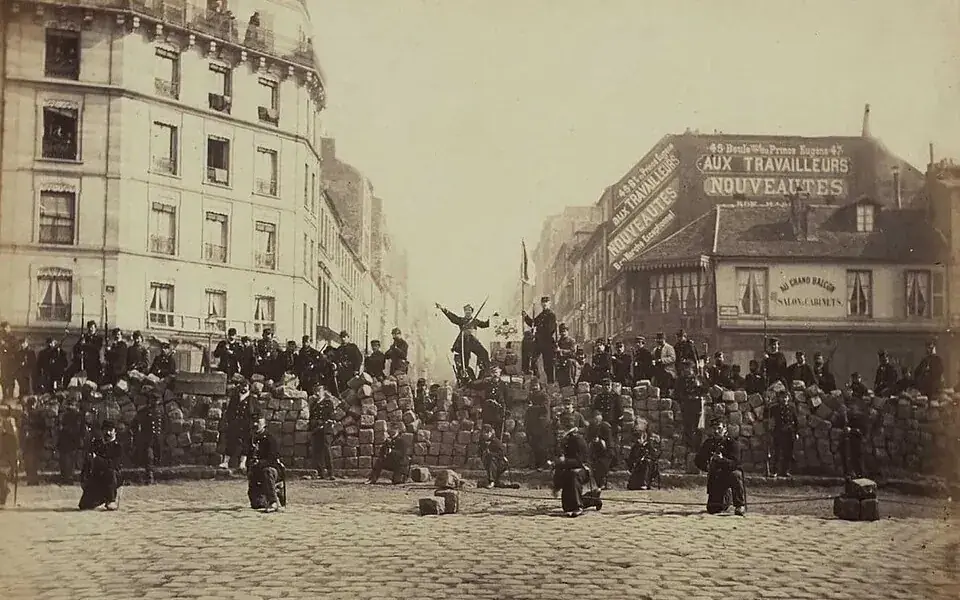
The Paris Commune was a French revolutionary government that seized power in Paris on 18 March 1871 and controlled parts of the city until 28 May 1871. During the Franco-Prussian War of 1870–1871, the French National Guard had defended Paris, and working class radicalism grew among its soldiers. Following the establishment of the French Third Republic in September 1870 (under French chief-executive Adolphe Thiers from February 1871) and the complete defeat of the French Army by the Germans by March 1871, soldiers of the National Guard seized control of the city on 18 March. The Communards killed two French Army generals and refused to accept the authority of the Third Republic; instead, the radicals set about establishing their own independent government.
Organisation and early work
The new Commune held its first meeting on 28 March in a euphoric mood. The members adopted a dozen proposals, including an honorary presidency for Blanqui; the abolition of the death penalty; the abolition of military conscription; a proposal to send delegates to other cities to help launch communes there; and a resolution declaring that membership in the Paris Commune was incompatible with being a member of the National Assembly. This was aimed particularly at Pierre Tirard, the republican mayor of the 2nd arrondissement, who had been elected to both Commune and National Assembly. Seeing the more radical political direction of the new Commune, Tirard and some twenty republicans decided it was wisest to resign from the Commune.
A resolution was also passed, after a long debate, that the deliberations of the council were to be secret, since the Commune was effectively at war with the government in Versailles and should not make its intentions known to the enemy.
Following the model proposed by the more radical members, the new government had no president, no mayor, and no commander in chief. The Commune began by establishing nine commissions, similar to those of the National Assembly, to manage the affairs of Paris. The commissions in turn reported to an Executive Commission. One of the first measures passed declared that military conscription was abolished, that no military force other than the National Guard could be formed or introduced into the capital, and that all healthy male citizens were members of the National Guard. The new system had one important weakness: the National Guard now had two different commanders. They reported to both the Central Committee of the National Guard and to the Executive Commission, and it was not clear which one was in charge of the inevitable war with Thiers' government.
21 May: Army enters Paris
The final offensive on Paris by MacMahon's army began on Sunday, 21 May. On the front line in the southwest, soldiers camped just outside the city learned from an agent inside the walls that the National Guard had withdrawn from one section of the city wall at Point-du-Jour, and that the fortifications were undefended. An army engineer crossed the moat and inspected the empty fortifications, and immediately telegraphed the news to Marshal MacMahon, who was with Thiers at Fort Mont-Valérien. MacMahon promptly gave orders, and two battalions passed through the fortifications without meeting resistance. The Versailles forces were able to swiftly capture the city gates of the Porte de Saint-Cloud, La Muette and the Porte de Versailles from inside. By four o'clock in the morning, fifty thousand soldiers had passed into the city, and advanced as far as the Champs-Élysées.
When he received the news from Dombrowski that the army was inside Paris, the Commune leader Delescluze refused to believe it, and refused to ring the bells to warn the city until the following morning. The trial of Gustave Cluseret, the former commander, was still going on at the Commune when they received the message from General Dombrowski that the army was inside the city. He asked for reinforcements and proposed an immediate counterattack. "Remain calm," he wrote, "and everything will be saved. We must not be defeated!". When they had received this news, the members of the Commune executive returned to their deliberations on the fate of Cluseret, which continued until eight o'clock that evening.
Aftermath
Some leaders of the Commune, including Delescluze, died on the barricades, but most of the others survived and lived long afterwards, and some of them resumed political careers in France. Between 1873 and 1876, 4,200 political prisoners were sent to the penal colony of New Caledonia. The convicts included about one thousand Communards, including Henri de Rochefort and Louise Michel.