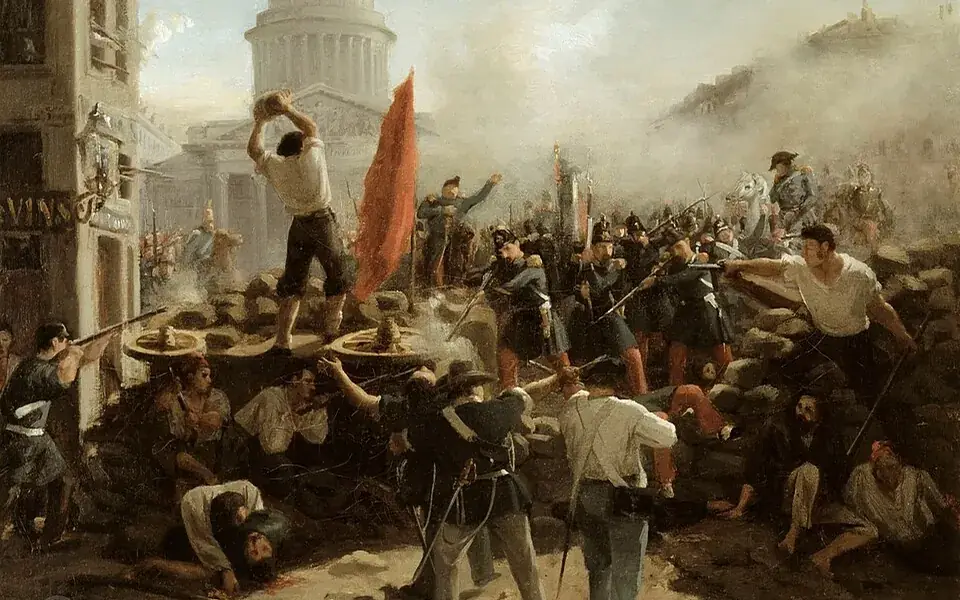
The revolutions of 1848, also known as the springtime of the peoples, were a series of revolutions throughout Europe that spanned almost two years, between January 1848 and October 1849. They remain the most widespread revolutionary wave in European history to date.
Background
The revolutions were shaped by a wide variety of causes, which were linked to the short- and long-term socioeconomic transformations brought about by industrialization and the political legacy of the French Revolution. These included the adoption of modern agricultural practices and subsequent rapid population growth, the intensification of industrialization and urbanization, the repressive political environment established in reaction to the French Revolution, and the spread of ideologies opposed to repressive governments, including liberalism, radicalism, and nationalism. In addition to longer-term trends, an acute economic crisis between 1845 and 1847, resulting from the combination of a food crisis and an industrial recession, led to significant civil unrest and revolutionary agitation. The failure of governments to adequately address popular demands for reform led to an accumulation of discontent across Europe, culminating in the simultaneous outbreak of revolutions across the continent in 1848.
France
The revolution against the July Monarchy in France began after the banning of the campagne des banquets, held to advocate for an expansion of the electoral franchise and to protest the conservative government of François Guizot. Protests began on 22 February in Paris, led largely by workers and students, and quickly escalated into a revolution, especially after the army's massacre of 65 demonstrators on 23 February. The revolution culminated on 24 February, when King Louis Philippe I abdicated and fled the country.
With the fall of the July Monarchy, a provisional government was formed, consisting of a coalition of moderate republicans and socialists, and the French Second Republic was proclaimed. Shortly after taking power, the provisional government instituted universal manhood suffrage and abolished slavery and the death penalty. To placate labour unrest, it recognized the right to work and established the publicly-run national workshops (ateliers nationaux) for the unemployed. Louis Blanc, a socialist member of the provisional government, was appointed to lead the Luxembourg Commission, consisting of workers' delegates, to investigate economic reforms to address the social question. Some actions proved unpopular in the provinces, such as the "commissioners of the republic" appointed as part of the regime change, whose conduct was criticized as dictatorial, and the 45 percent increase in the property tax to pay for the government's growing expenses.
Aftermath and legacy
Liberal democrats looked to 1848 as a democratic revolution, which in the long run ensured liberty, equality, and fraternity. For nationalists, 1848 was the springtime of hope, when newly emerging nationalities rejected the old multinational empires, but the results were not as comprehensive as many had hoped. Communists denounced 1848 as a betrayal of working-class ideals by a bourgeoisie indifferent to the legitimate demands of the proletariat. The view of the revolutions of 1848 as a bourgeois revolution is also common in non-Marxist scholarship. Tensions over differing approaches between bourgeois revolutionaries and radicals played a major role in the failure of the revolutions. Many governments engaged in a partial reversal of the revolutionary reforms of 1848–1849 as well as heightened repression and censorship.
The Hanoverian nobility successfully appealed to the Confederal Diet in 1851 over the loss of their noble privileges, while the Prussian Junkers recovered their manorial police powers from 1852 to 1855. In the Austrian Empire, the Sylvester Patents (1851) discarded Franz Stadion's constitution and the Statute of Basic Rights, while the number of arrests in Habsburg territories increased from 70,000 in 1850 to one million by 1854. Nicholas I's rule in Russia after 1848 was particularly repressive, marked by an expansion of the secret police (the Tretiye Otdeleniye) and stricter censorship; more Russians were working for censorship organs than actual books published in the period immediately after 1848. In France, the works of Charles Baudelaire, Victor Hugo, Alexandre Ledru-Rollin, and Pierre-Joseph Proudhon were confiscated.