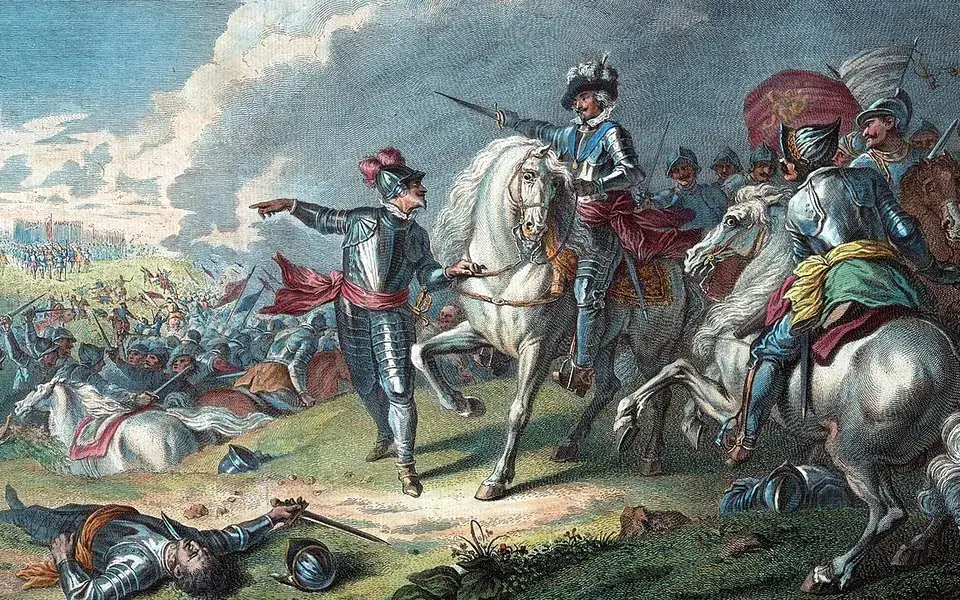
The English Civil War or Great Rebellion was a series of civil wars and political machinations between Royalists and Parliamentarians in the Kingdom of England from 1642 to 1651. Part of the wider 1639 to 1653 Wars of the Three Kingdoms, the struggle consisted of the First English Civil War and the Second English Civil War. The Anglo-Scottish war of 1650 to 1652 is sometimes referred to as the Third English Civil War.
Background
The English Civil War broke out in 1642, less than 40 years after the death of Queen Elizabeth I. Elizabeth had been succeeded by her first cousin twice-removed, King James VI of Scotland, as James I of England, creating the first personal union of the Scottish and English kingdoms. As King of Scots, James had become accustomed to Scotland's weak parliamentary tradition since assuming control of the Scottish government in 1583, so that upon assuming power south of the border, the new King of England was affronted by the constraints the English Parliament attempted to place on him in exchange for money. Consequently, James's personal extravagance, which resulted in him being perennially short of money, meant that he had to resort to extra-parliamentary sources of income.
Moreover, increasing inflation during this period meant that even though Parliament was granting the King the same nominal value of subsidy, the income was actually worth less.
First English Civil War (1642–1646)
In early January 1642, a few days after failing to capture five members of the House of Commons, Charles feared for the safety of his family and retinue and left the London area for the north country. Further frequent negotiations by letter between the King and the Long Parliament, through to early summer, proved fruitless. On 1 June the English Lords and Commons approved a list of proposals known as the Nineteen Propositions. In these demands, the Parliament sought a larger share of power in the governance of the kingdom. Before the end of the month the King rejected the Propositions.
As the summer progressed, cities and towns declared their sympathies for one faction or the other: for example, the garrison of Portsmouth commanded by George Goring declared for the King, but when Charles tried to acquire arms from Kingston upon Hull, the weaponry depository used in the previous Scottish campaigns, John Hotham, the military governor appointed by Parliament in January, refused to let Charles enter the town, and when Charles returned with more men later, Hotham drove them off. Charles issued a warrant for Hotham's arrest as a traitor but was powerless to enforce it. Throughout the summer, tensions rose and there was brawling in several places, the first death from the conflict taking place in Manchester.
Second English Civil War (1648–1649)
Charles I took advantage of the deflection of attention away from himself to negotiate on 28 December 1647 a secret treaty with the Scots, again promising church reform. Under the agreement, called the "Engagement", the Scots undertook to invade England on Charles's behalf and restore him to the throne. A series of Royalist uprisings throughout England and a Scottish invasion occurred in the summer of 1648. Forces loyal to Parliament put down most of those in England after little more than a skirmish, but uprisings in Kent, Essex and Cumberland, the rebellion in Wales, and the Scottish invasion involved pitched battles and prolonged sieges.
In the spring of 1648, unpaid Parliamentarian troops in Wales changed sides. Colonel Thomas Horton defeated the Royalist rebels at the Battle of St Fagans (8 May) and the rebel leaders surrendered to Cromwell on 11 July after a protracted two-month siege of Pembroke. Thomas Fairfax defeated a Royalist uprising in Kent at the Battle of Maidstone on 1 June. Fairfax, after his success at Maidstone and the pacification of Kent, turned north to reduce Essex, where, under an ardent, experienced and popular leader, Charles Lucas, the Royalists had taken up arms in great numbers. Fairfax soon drove the enemy into Colchester, but his first attack on the town met with a repulse and he had to settle down to a long siege.