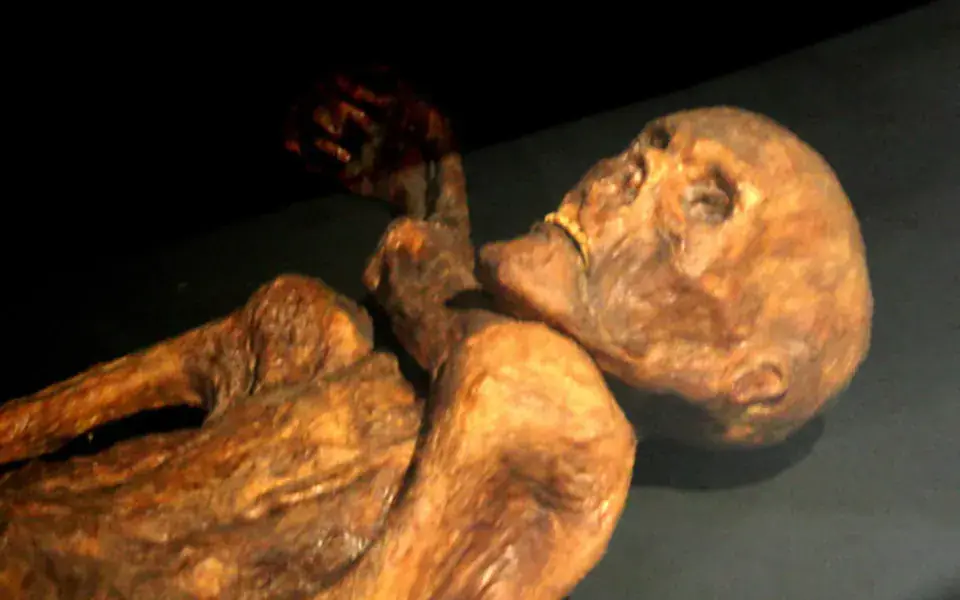
Ötzi ( c. 3275 BC – c. 3230 BC), also called The Iceman, Similaun man, or Tyrolean Iceman, is the natural mummy of a man who lived during the 4th millennium BC. Ötzi's remains were discovered on 19 September 1991 in the Ötztal Alps (hence the nickname "Ötzi") at the Austria–Italy border. He is Europe's oldest known natural human mummy, showing an unprecedented view of Chalcolithic (Copper Age) Europeans.
Discovery
Attempts to recover his body began the next day but were delayed by bad weather and continued until 23 September. During this time, mountaineers Reinhold Messner and Hans Kammerlander examined some of Ötzi's belongings, including leather clothing, birch bark containers and an axe. After seeing a drawing of the axe, Messner suggested that the remains might be much older than first thought.
Before Ötzi was recovered, several people visited the site. Fragile objects were stepped on and others were removed before their locations had been recorded, destroying some evidence about where his belongings had originally been lying. Researchers later interviewed visitors to reconstruct the locations of the finds. Ötzi was finally removed from the ice on 23 September, four days after his discovery. No archaeologist was present. A dagger was found beside him, and a long wooden object nearby was later identified as a bow. His body was flown to Vent and then taken to the Institute of Forensic Medicine in Innsbruck for examination.
It was still unclear whether Ötzi had been found in Austria or Italy. The border established under the Treaty of Saint-Germain-en-Laye of 1919 was intended to follow the Alpine watershed, but snow and ice had made the area difficult to map accurately. On 2 October, thirteen days after Ötzi's discovery, an official survey placed the find site 92.56 metres (101.22 yd) inside Italy, in South Tyrol. South Tyrol claimed ownership of Ötzi, but agreed that his body could remain temporarily in Innsbruck while examinations continued.
Clothes
Ötzi wore a cloak made of woven grass and a coat, a belt, a pair of leggings, a loincloth, and shoes, all made of leather of different skins. He also wore a bearskin cap with a leather chin strap. The coat, belt, leggings and loincloth were constructed of vertical strips of leather sewn together with sinew. His belt had a pouch sewn to it that contained a cache of useful items: a scraper, a drill, a flint flake, a bone awl and a dried fungus.
Tools and equipment
Other items found with the Iceman were a copper axe with a yew handle, a chert-bladed knife with an ash handle and a quiver of 14 arrows with viburnum and dogwood shafts. Two of the arrows, which were broken, were tipped with flint and had fletching (stabilizing fins), while the other 12 were unfinished and untipped. The arrows were found in a quiver with what is presumed to be a bow string, an unidentified tool, and an antler tool which might have been used for sharpening arrow points. There was also an unfinished yew longbow that was 1.82 m (72 in) long.
Among Ötzi's possessions were berries, two birch bark baskets, and two species of polypore mushrooms with leather strings through them. One of these, the birch fungus, is known to have anthelmintic properties, and was probably used for medicinal purposes. The other was a type of tinder fungus, included with part of what appeared to be a complex firelighting kit. The kit featured pieces of over a dozen different plants, in addition to flint and pyrite for creating sparks.
Ötzi's copper axe was of particular interest. His axe's haft is 60 cm (24 in) long and made from carefully worked yew with a right-angled crook at the shoulder, leading to the blade. The 9.5-centimetre-long (3.7 in) axe head is almost pure copper. It was produced through casting and did not undergo mechanical hardening. Though copper ore sources in the Alpines are known to have been exploited in Ötzi's time, a 2017 study indicated that the copper in the axe came from southern Tuscany. It was let into the forked end of the crook and fixed there using birch-tar and tight leather lashing. The blade part of the head extends out of the lashing and shows clear signs of having been used to chop and cut. Such an axe would have been a valuable possession, important both as a tool and as a status symbol.