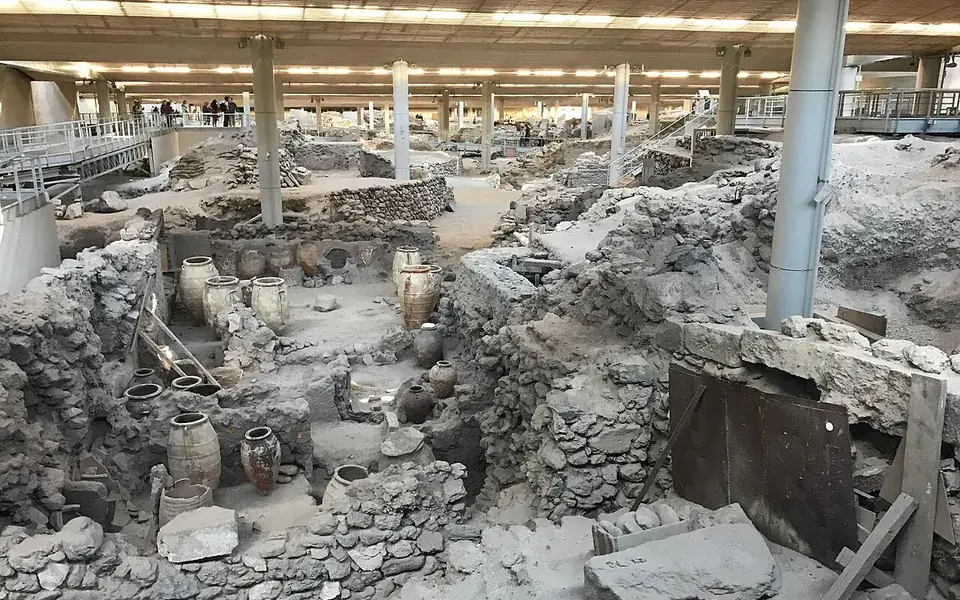
Akrotiri was a prosperous Bronze Age settlement on Santorini with paved streets, drainage, multi-storey buildings, and vivid wall paintings. A volcanic eruption buried the town in ash. Excavation exposed evidence of Aegean trade and daily life, while the eruption’s precise date remains a subject of debate.
History
The earliest evidence for human habitation of Akrotiri can be traced back as early as the fifth millennium BCE when it was a small fishing and farming village. By the end of the third millennium, this community developed and expanded significantly. One factor for Akrotiri's growth may be the trade relations it established with other cultures in the Aegean, as evidenced in fragments of foreign pottery at the site. Akrotiri's strategic position on the primary sailing route between Cyprus and Minoan Crete also made it an important point for the copper trade, thus allowing it to become an important centre for processing copper, as proven by the discovery of moulds and crucibles there.
Akrotiri's prosperity continued for about another 500 years; paved streets, an extensive drainage system, the production of high-quality pottery and further craft specialization all point to the level of sophistication achieved by the settlement. This all came to an end, however, in the 16th century BC with the volcanic eruption of Thera. There is a variety of dating evidence for the eruption, but its exact year is not known. Radiocarbon dating places it most probably between 1620 and 1530 BC, which is also in accord with the date range of 1570 to 1500 BC suggested by similarities of the material culture with other sites in the Aegean. Unusual growth patterns observed in tree rings in 1597, 1560, 1546 and 1544 BC are consistent with a major volcanic event in any of those years. The latter three dates might be the best candidates as they are also considered possible for Egyptian New Kingdom records that are thought to refer to the eruption.
Excavations
Akrotiri was buried by the massive Theran eruption in the middle of the second millennium BC (during the Late Minoan IA period); as a result, like the Roman ruins of Pompeii after it, it is remarkably well-preserved. Frescoes, pottery, furniture, advanced drainage systems and three-story buildings have been discovered at the site. The earliest excavations on the island of Santorini were conducted by French geologist F. Fouque in 1867 after some local people found old artifacts at a quarry. Later, in 1895–1900, the digs by German archeologist Baron Friedrich Hiller von Gaertringen revealed the ruins of ancient Thera on Mesa Vouno, which date from the archaic period, much after the Minoan eruption. Also, a little later, R. Zahn excavated in the locality of Potamos, near Akrotiri, under the auspices of the German Archaeological Institute at Athens.
The extensive modern excavation was started in 1967 by Spyridon Marinatos and revealed the full value of this site. Marinatos's choice of the site proved to be correct and a few hours into the excavation, the remains of the buried city began to be discovered. The next step was to determine the extent of the city, which took two seasons devoted to the site in 1967 and 1968. In the early years of the excavation, a great deal of attention was paid towards the organization of proper facilities for the dig, including substantial workshops, laboratories built for storage, repair, and treatment, and areas for examination of archaeological finds.
Frescoes
The frescoes in Akrotiri are especially important for the study of Minoan art because they are much better preserved than those that were already known from Knossos and other sites on Crete, which have nearly all survived only in small fragments, usually fallen to the ground. All of the pigments used by the artists at Akrotiri for painting the frescoes look as though they are mineral based and thus have resulted in the great preservation of the pieces. The colors used in Theran painting include white, yellow, red, brown, blue and black. The technique used is not true fresco, except for a few isolated instances, and instead appears as though the painting was begun while the plaster was still wet, but as though the artist made no effort to keep it wet, and seemed content to complete the work on a dry surface. As a result, often on the same fresco, the paint has penetrated the plaster in some areas but flakes off easily in others.