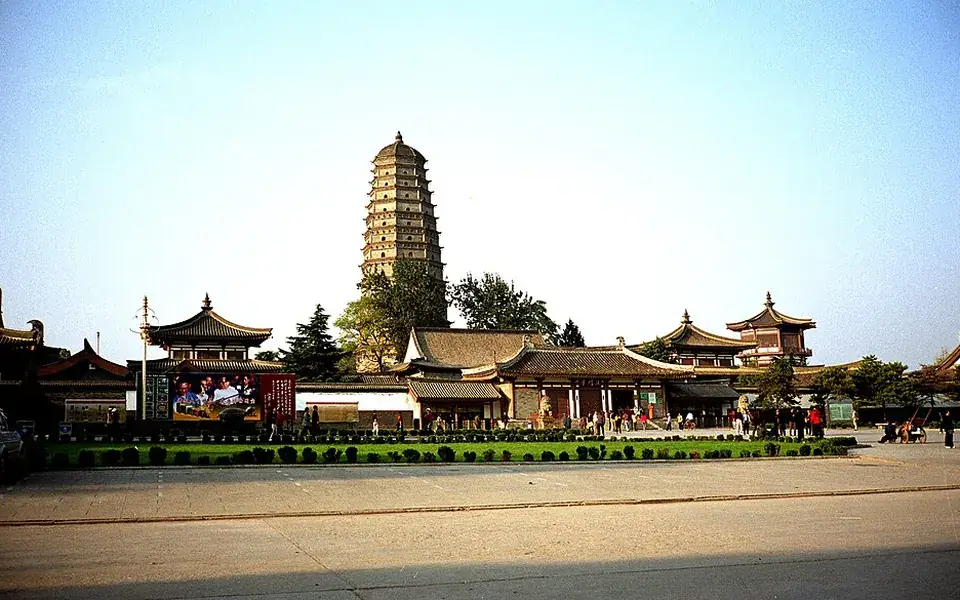
After the pagoda at Famen Temple collapsed, archaeological excavations uncovered an underground chamber and Tang artifacts, including gold and silver objects, ceramics, and textiles. Comparing its documents and objects provides rich evidence for Tang Buddhist offerings, court life, and craftsmanship.
Historical background
Famen Temple is a Buddhist temple located in Famen town, Fufeng County, 120 kilometers west of Xi'an, Shaanxi, China. It is widely regarded as the "ancestor of pagoda temples in Guanzhong".
Famen Temple entered its halcyon days after formation of the Tang dynasty (618–907). During the first year of the reign of Wude of the Tang dynasty (618), it was named Famen Temple, and monks were recruited the following year. Later, the temple took in homeless people fleeing chaos caused by war at the end of the Sui dynasty, and was unfortunately burned. It was rebuilt later by monks. In Zhenguan 5th year (631), Zhang Liang was appointed to demolish Wangyun Palace to build the pagoda. It was rebuilt in Gaozong Xianqing 5th year (660), and was a four-storied pavilion-like pagoda. It was named later by Tang Zhongzong True Relic Pagoda. Tang Zhongzong actively advocated Buddhism, and along with Empress Wei buried their hair under the pagoda (unearthed in autumn 1978).
Jinglong 4th year (710), the temple was renamed Grand Empire Carefree King Temple, and the pagoda Grand True Relic Pagoda. In Wenzong Kaicheng 3rd year (AD 838), it was renamed Fayun Temple, but soon reverted to the name Famen. When Buddhism was suppressed in Huichang in the year of Wuzong, Famen Temple was affected. During Yizong's reign, the last Buddha relic acquisition in the Tang dynasty took place. At that time, Famen Temple was rebuilt, and its underground palace was not later altered.
People's Republic of China
After the establishment of the People's Republic of China, Famen Temple was among the first key protected historical relics of the province. However, the properties of the temple were still appropriated for public uses, such as schools in Famen town. During the Cultural Revolution, the Red Guard damaged temple halls and Buddhist figures under the name of "breaking four old fashions". The abbot, Liangqing, incinerated himself in front of the True Relic Pagoda, in order to protect temple's underground palace. When the palace was unearthed later, the relic of self-immolation could still be seen. Other monks were either demobilized or killed. The temple became "the temporary headquarters of proletariat rebellion of Fufeng County".
After 1979, Shaanxi province government once funded restoration of the Mahavira Hall and the Brass Buddha Pavilion. At 1:57 a.m. on 4 August 1981, half of the side wall of True Relic Pagoda collapsed in the heavy rain. This incident drew universal attention. In 1984, the government implemented religious policy and handed over Famen Temple to the Buddhist community. In 1985, Shaanxi province government decided to pull down the remaining half side wall and rebuild the True Relic Pagoda. On 3 April 1987, the underground palace of True Relic Pagoda in Famen Temple was opened, and large quantities of precious historical relics were unearthed. The expansion of the temple and the reconstruction of the pagoda were completed in October 1988. On 9 November of the same year, the Famen Temple Museum was opened.
Buddha's relics
When the underground chamber was opened in May 1987, four objects associated with Buddhist relic veneration were found. The temple's tradition identifies one as the Buddha's finger relic and classifies the others as accompanying substitutes. These religious identifications explain the chamber's devotional importance and the site's renewed role in pilgrimage. They should be distinguished from independently established biological provenance. The discovery preserved an exceptional setting in which precious containers, offerings, and objects of veneration had been placed together.
The object venerated as the finger relic was preserved in the innermost box in a set of eight boxes, each of which encloses the next-smallest box wrapped in a layer of thin silk. The outermost box was in sandalwood and had rotted away, but the smaller boxes were in gold, some in silver, and one in jade, and are in a good state of preservation. Each box has a silver lock and was exquisitely carved.