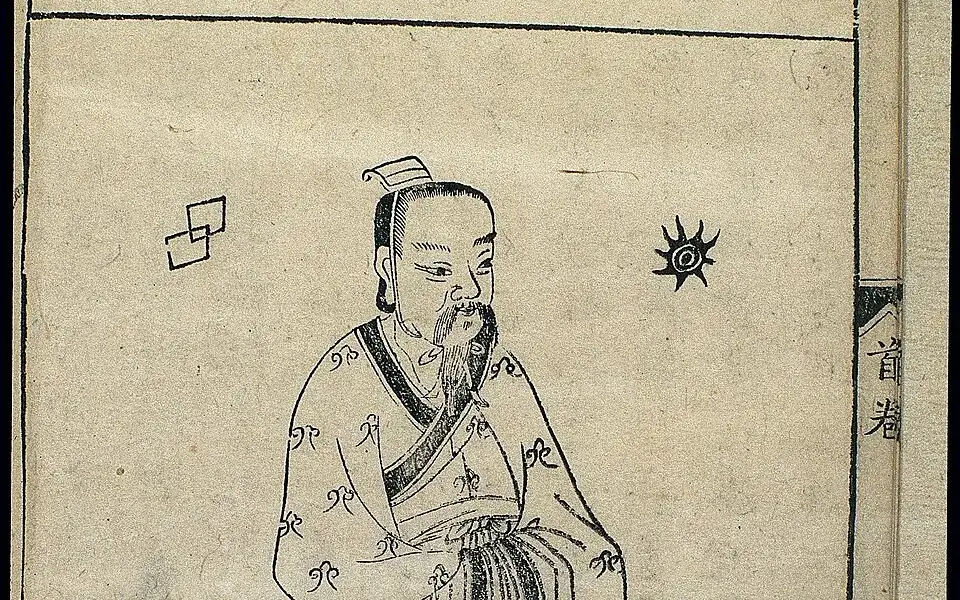
Bian Que occupies an important place in ancient medical history and literature. His exploits appear in surviving texts, although his dates and the origins of the stories remain debated. Later generations attached many diagnostic and treatment tales to this name. The image of a celebrated physician can arise from enduring cultural memory as well as an individual life.
Historical background
Bian Que was an ancient Chinese figure traditionally said to be the earliest known Chinese physician during the Warring States period. His real name is said to be Qin Yueren, but his medical skills were so amazing that people gave him the same name as the (original) legendary doctor Bian Que, from the time of the Yellow Emperor. He was a native of the State of Qi.
According to the legend recorded in the Records of the Grand Historian, he was gifted with clairvoyance from a deity when he was working as an attendant at a hostel that catered to the nobility. It was there he encountered an old man who had stayed there for many years. Thankful for Bian Que's attentive service and politeness, the old man gave him a packet of medicine which he told Bian Que to boil in water. After taking this medicine, Bian Que gained the ability to see through the human body and thereby became an excellent diagnostician with X-ray-like ability. He also excelled in pulse taking and acupuncture therapy. He is ascribed the authorship of the Bian Que Neijing (Internal Classic of Bian Que).
Han dynasty physicians claimed to have studied his works, which have since been lost. Tales state that he was a doctor of many disciplines, conforming to the local needs wherever he went. For example, in one city he was a children's doctor, and in another a female physician.
One famous legend tells of how once when Bian Que was in the State of Cai, he saw the lord of the state at the time and told him that he had a disease, which Bian Que claimed was only in his skin. The lord brushed this aside as at that time he felt no symptoms, and told his attendants that Bian Que was just trying to profit from the fears of others. Bian Que is said to have visited the lord many times thereafter, telling him each time how this sickness was becoming progressively worse, each time spreading into more of his body, from his skin to his blood and to his organs.
The last time Bian Que went to see the lord, he looked in from afar, and rushed out of the palace. When an attendant of the lord asked him why he had done this, he replied that the disease was in the marrow and was incurable. The lord was said to have died soon after.
Another legend stated that once, while visiting the state of Guo, he saw people mourning on the streets. Upon inquiring what their grievances were, he got the reply that the heir apparent of the lord had died, and the lord was in mourning. Sensing something afoot, he is said to have gone to the palace to inquire about the circumstances of the death. After hearing of how the prince "died", he concluded that the prince had not really died, but was rather in a coma-like state. He set a single acupuncture needle in the Baihui point on the head, helping the prince to regain consciousness. Herbal medicine was boiled to help the prince sit up, and after Bian Que prescribed the prince with more herbal medicine, the prince healed fully within twenty days.
The tradition associated with Bian Que also credits him with diagnostic methods based on looking at outward signs, listening, asking about symptoms, and taking the pulse. Like the other stories attached to his name, this attribution should be understood within the history of his medical reputation. It records the kinds of observation later writers connected with a celebrated physician, while the uncertain biography prevents every traditional claim from being assigned confidently to one historical individual.
The Daoist Liezi has a legend (tr. Giles 1912:81-83) that Bian Que used anesthesia to perform a double heart transplantation, with the xin, or heart, as the seat of consciousness. Gong Hu from the state of Lu and Qi Ying from the state of Zhao had opposite imbalances of qi "breath; life-force" and zhi "will; intention". Gong had a qi ("mental power") deficiency while Qi had a zhi ("willpower") deficiency.