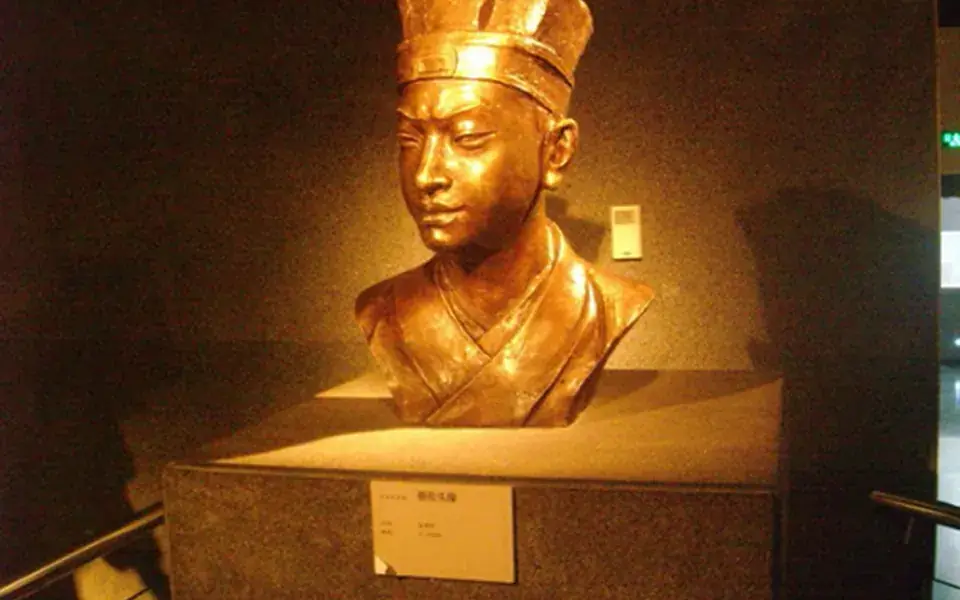
Cai Lun served as director of the imperial workshops during the Eastern Han and participated in making palace equipment. His papermaking work was therefore connected with court craftsmanship and materials management. Historical accounts say he broadened the materials used for paper to include bark, rags, hemp waste, and fishing nets. Improving and promoting the process does not mean that the earliest paper appeared only at that time.
From the court to the workshop
Cai Lun was born in Guiyang Commandery in the Eastern Han dynasty (25–220 CE). His exact year of birth is unknown; estimates include c. 50, c. 57, and c. 62. Other than being born into a poor family, virtually nothing is known of his early life. Guiyang was a southern commandery, where Han Chinese had immigrated for hundreds of years to plant and cultivate rice. Legends suggest there was a pool near his home, south of which was a stone mortar that Cai would later use for papermaking.
It is not known how Cai came to be in the service of the imperial court in Luoyang (modern-day Luoyang, Henan province), which was distant from his birthplace. The Hou Hanshu reports that he was first employed during the end of the Yongping era (58–75) of Emperor Ming. The site of modern Guiyang Commandery was known to have had various iron mines at the time, so the former director of the Paper Museum in Tokyo, Kiyofusa Narita, suggested that "through the assistance of some who were in charge of the iron foundry, he found opportunity to go to the capital city".
Imperial production and craftsmanship
Cai's court career brought him both political responsibilities and a practical role in imperial production. He became a regular attendant and was also appointed prefect of the Palace Workshop, an office concerned with instruments and weapons made for imperial use. His position gave him contact with organized craftsmanship and the materials used by the court. The biographical account therefore presents papermaking within a much broader career, rather than as the isolated activity of an artisan whose only task was to make paper.
The workshop appointment continued as political circumstances changed. In 97 CE, Cai's responsibilities expanded to include ceremonial swords and other objects. The Book of the Later Han praised the quality of his craftsmanship and treated it as a model for later work. These details help explain why a papermaking improvement could be connected with his name: his official role already involved the supervision of skilled production. They do not establish that every part of the process was his individual discovery.
Paper as an evolving technology
Writing had a long history in China. The most common writing surfaces were bamboo and wooden slips, with wood for short text and bamboo for lengthy text. These media were inconvenient as they were awkward to store, heavy, and difficult to write on. After Meng Tian purportedly created an animal-hair brush for writing in 3rd-century BCE, silk and cloth emerged as alternatives that addressed these issues, but they were too expensive for widespread use. The absence of a practical solution motivated continued experimentation with different materials. In 105, Cai publicly declared that he had invented a new composition for paper with a new papermaking process. Cai's pulp solution proved the most effective solution.
His process still used bamboo, but also introduced hemp waste, old rags, fishnets, and most importantly, bark from trees (likely mulberry). The materials were boiled to a pulp that was beaten with a wood or stone mallet before being mixed with a large amount of water. The resulting mixture was then processed with wooden sieves and the excess water removed, leaving the paper finished once dry. The paper that resulted from this method is often referred to as "Cai Hou paper".
Archaeological finds show that forms of paper existed before Cai's lifetime. His historical importance is therefore commonly understood as improving and promoting an existing technology, particularly through the materials associated with his process. The earlier evidence and the later biography answer different questions. Excavated paper establishes that the material was already being made; the account of Cai records a recognized improvement and its court setting. Read together, they support a more precise explanation than a story of paper appearing suddenly through one person's invention.