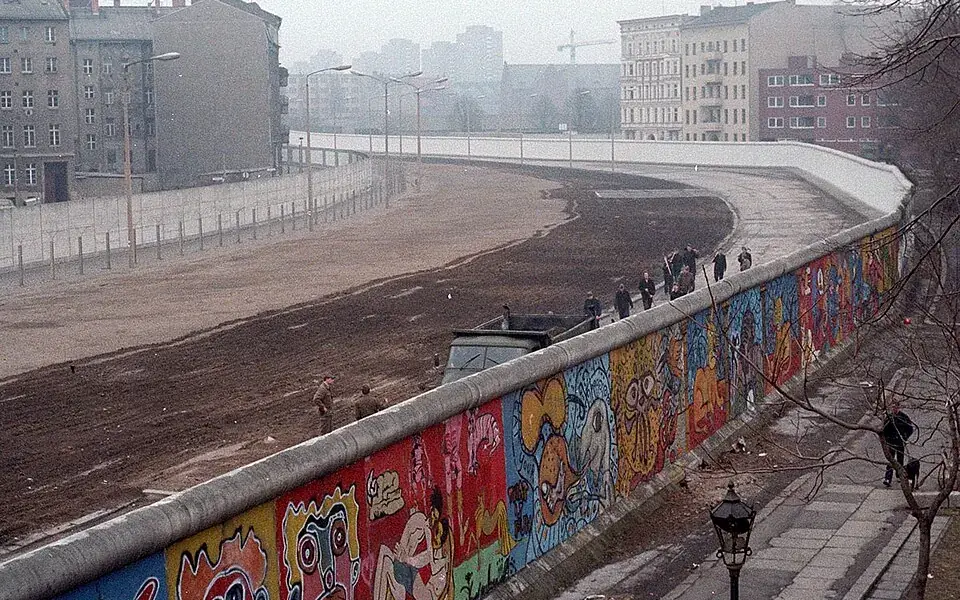
Built in 1961, the Berlin Wall divided the city and restricted movement, profoundly affecting families, work, and transport. The opening of the border in 1989 became a symbol of a turning point in the Cold War. Dismantling the wall and German reunification followed through further stages, rather than occurring in a single instant.
Post-war Germany
After the end of World War II in Europe, what remained of pre-war Germany west of the Oder-Neisse line was divided into four occupation zones (as per the Potsdam Agreement), each one controlled by one of the four occupying Allied powers: the United States, the United Kingdom, France and the Soviet Union. The capital, Berlin, as the seat of the Allied Control Council, was similarly subdivided into four sectors despite the city's location, which was fully within the Soviet zone.
Within two years, political divisions increased between the Soviets and the other occupying powers. These included the Soviets' refusal to agree to reconstruction plans making post-war Germany self-sufficient, and to a detailed accounting of industrial plants, goods and infrastructure—some of which had already been removed by the Soviets. France, the United Kingdom, the United States, and the Benelux countries later met to combine the non-Soviet zones of Germany into one zone for reconstruction, and to approve the extension of the Marshall Plan.
Start of the construction (1961)
On 15 June 1961, First Secretary of the Socialist Unity Party and GDR State Council chairman Walter Ulbricht stated in an international press conference, "Niemand hat die Absicht, eine Mauer zu errichten!" (No one has the intention of erecting a wall!). It was the first time the colloquial term Mauer (wall) had been used in this context.
The transcript of a telephone call between Nikita Khrushchev and Ulbricht, on 1 August in the same year, suggests that the initiative for the construction of the Wall came from Khrushchev. However, other sources suggest that Khrushchev had initially been wary about building a wall, fearing negative Western reaction. Nevertheless, Ulbricht had pushed for a border closure for some time, arguing that East Germany's existence was at stake.
Khrushchev had become emboldened upon seeing US president John F. Kennedy's youth and inexperience, which he considered a weakness. In the 1961 Vienna summit, Kennedy made the error of admitting that the US would not actively oppose the building of a barrier. A feeling of miscalculation and failure immediately afterwards was admitted by Kennedy in a candid interview with New York Times columnist James "Scotty" Reston. On Saturday, 12 August 1961, the leaders of the GDR attended a garden party at a government guesthouse in Döllnsee, in a wooded area to the north of East Berlin. There, Ulbricht signed the order to close the border and erect a wall.
Immediate effects
With the closing of the east–west sector boundary in Berlin, the vast majority of East Germans could no longer travel or emigrate to West Germany. Berlin soon went from being the easiest place to make an unauthorized crossing between East and West Germany to being the most difficult. Many families were split, while East Berliners employed in the West were cut off from their jobs. West Berlin became an isolated exclave in a hostile land. West Berliners demonstrated against the Wall, led by their Mayor (Oberbürgermeister) Willy Brandt, who criticized the United States for failing to respond and went so far as to suggest to Washington what to do next. Kennedy was furious.
Allied intelligence agencies had hypothesized about a wall to stop the flood of refugees, but the main candidate for its location was around the perimeter of the city. In 1961, Secretary of State Dean Rusk proclaimed, "The Wall certainly ought not to be a permanent feature of the European landscape. I see no reason why the Soviet Union should think it is to their advantage in any way to leave there that monument to communist failure."
Official crossings and usage
There were nine border crossings between East and West Berlin. These allowed visits by West Berliners, other West Germans, Western foreigners and Allied personnel into East Berlin, as well as visits by GDR citizens and citizens of other socialist countries into West Berlin, provided that they held the necessary permits. These crossings were restricted according to which nationality was allowed to use it (East Germans, West Germans, West Berliners, other countries). The best known was the vehicle and pedestrian checkpoint at the corner of Friedrichstraße and Zimmerstraße (Checkpoint Charlie), which was restricted to Allied personnel and foreigners.