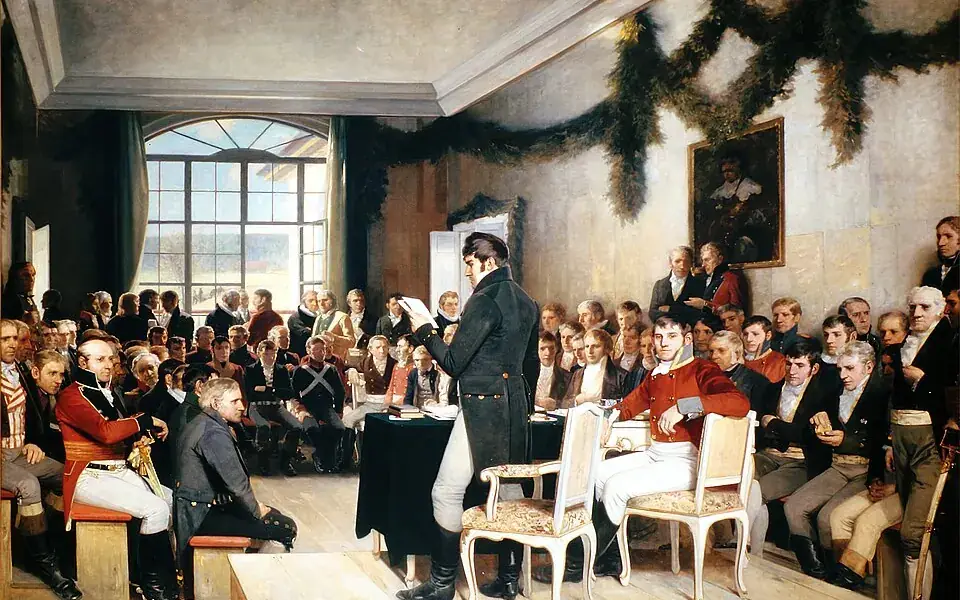
Norway adopted a constitution amid the political changes of 1814, addressing sovereignty, representation, and the arrangement of power. It remained important even after Norway entered a union with Sweden. May 17 became a national commemorative day. The constitution has been revised over time, and the scope of civic participation has changed with society.
Historical background
The Constitution of Norway (complete name: The Constitution of the Kingdom of Norway; Danish: Kongeriget Norges Grundlov; Norwegian Bokmål: Kongeriket Norges Grunnlov; Norwegian Nynorsk: Kongeriket Noregs Grunnlov) was adopted on 16 May and signed on 17 May 1814 by the Norwegian Constituent Assembly at Eidsvoll. The latter date is the National Day of Norway; it marks the establishment of the constitution.
It is the fourth oldest written single-document national constitution in Europe after the Constitution of Poland, the French constitution of 1791, and the Spanish Constitution of 1812. The document is also the second oldest working national constitution in the world, after the Constitution of the United States. In May 2014, the Storting passed the most substantial changes since 1814, particularly by including paragraphs on human rights.
Writing the constitution
Until 1814, Norway was part of the Kingdom of Denmark–Norway. Following the defeat of Napoleon's troops at the Battle of Leipzig in October 1813, the Treaty of Kiel of January 1814 ceded Norway to Sweden. In response, the Crown Prince of Denmark–Norway and resident viceroy in Norway, Christian Frederik, started a Norwegian independence movement. The most likely goal of the young Crown Prince was reunification with Denmark. His initiative was successful, and a national assembly at Eidsvoll Manor was called. The assembled representatives were elected by the congregations of the state church and by military units throughout Norway.They convened at the Eidsvoll Manor on 10 April. The constitution was written during five weeks of the spring of 1814. It was ratified by the assembly on 16 May, and signed the following day. The latter date is now celebrated as the Norwegian Constitution Day.
The Norwegian constitution was inspired by the United States Declaration of Independence in 1776 and the French Revolution in 1789, and the subsequent U.S. and French constitutions. The authors, Christian Magnus Falsen and Johan Gunder Adler, were also influenced by the Spanish Constitution of 1812. A deviation from the republican constitutions of France and the United States was the retention of monarchy. Importing republicanism was seen as an attempt to emulate the French and Americans directly, something the lawmakers at Eidsvoll sought to avoid. The choice of monarchy as state form would also facilitate the reunification of Denmark–Norway, something the Crown Prince was not alone in seeking. The constitution only granted the king the power of suspensive veto.
The council of Eidsvoll chose Crown Prince Christian Frederik as king. Christian Adolph Diriks, who was the legal secretary of the Constitutional Committee, was the assembly's resident expert on foreign constitutions, and played an important part in shaping the language of the constitution. Diriks is credited with formulating.100, concerning freedom of speech, and.102, guarding against unreasonable searches and seizures.
The union with Sweden
The young king and Norwegian officials tried to find international backing for their bid for Norway as a sovereign state throughout spring and early summer of 1814. After failing to secure the support of the United Kingdom, war with Sweden became unavoidable. The Swedish Campaign against Norway was short and decisive. However, while badly trained and equipped, the Norwegian Army put up a determined fight, holding the Swedes back at Kongsvinger and securing a tactical victory at the battle of Langnes. This enabled the King to avoid an unconditional surrender as he was forced into negotiations with the Swedes, leading to the Convention of Moss.
Putting the strategic situation and his own abdication to good use, he persuaded the Swedish crown prince Carl Johan (the former Marshal Bernadotte of France) to let the Norwegians keep their constitution. The Swedish crown prince could have named his terms to Norway, but wanted to appease the Norwegians and avoid a bloody continuation of the war. Realizing that a forced union with himself as ruler of a conquered and hostile country would be very uneasy, he accepted the Norwegian proposition. Norway then entered into a personal union with Sweden, and the constitution was amended as necessary to form the Union between Sweden and Norway.