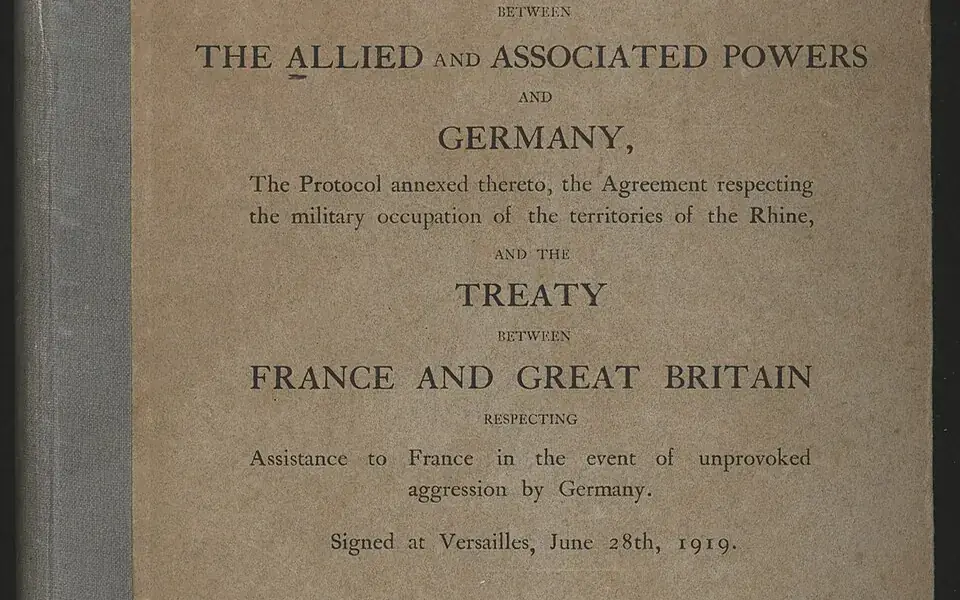
The Treaty of Versailles, signed in 1919, set provisions concerning Germany's territory, armed forces, and reparations. It was also connected with the establishment of the League of Nations. Negotiating and implementing the treaty produced lasting controversy. Its consequences need to be understood alongside economics, politics, and other postwar arrangements, rather than through a single cause.
Historical background
The Treaty of Versailles was a peace treaty signed on 28 June 1919. As the most important treaty of World War I, it ended the state of war between Germany and most of the Allied Powers. It was signed in the Palace of Versailles, exactly five years after the assassination of Archduke Franz Ferdinand, the proximate cause of the war. The other Central Powers on the German side signed separate treaties. Although the armistice of 11 November 1918 ended the actual fighting, and agreed certain principles and conditions including the payment of reparations, it took six months of Allied negotiations at the Paris Peace Conference to conclude the peace treaty. Germany was not allowed to participate in the negotiations before signing the treaty.
The treaty required Germany to disarm, make territorial concessions, extradite alleged war criminals, agree to Kaiser Wilhelm being put on trial, recognise the independence of states whose territory had previously been part of the German Empire, and pay reparations to the Entente powers.
Negotiations
Talks between the Allies to establish a common negotiating position started on 18 January 1919, in the Salle de l'Horloge (Clock Room) at the French Foreign Ministry on the Quai d'Orsay in Paris. Initially, 70 delegates from 27 nations participated in the negotiations. Russia was excluded due to their signing of a separate peace (the Treaty of Brest-Litovsk) and early withdrawal from the war. Furthermore, German negotiators were excluded to deny them an opportunity to divide the Allies diplomatically.
Initially, a "Council of Ten" (comprising two delegates each from Britain, France, the United States, Italy, and Japan) met officially to decide the peace terms. This council was replaced by the "Council of Five", formed from each country's foreign ministers, to discuss minor matters. French Prime Minister Georges Clemenceau, Italian Prime Minister Vittorio Emanuele Orlando, British Prime Minister David Lloyd George, and United States President Woodrow Wilson formed the "Big Four" (at one point becoming the "Big Three" following the temporary withdrawal of Orlando). These four men met in 145 closed sessions to make all the major decisions, which were later ratified by the entire assembly. The minor powers attended a weekly "Plenary Conference" that discussed issues in a general forum but made no decisions.
French aims
France had lost 1.3 million soldiers, including 25% of French men aged 18–30, as well as 400,000 civilians. France had also been more physically damaged than any other nation; the so-called zone rouge (Red Zone), the most industrialized region and the source of most coal and iron ore in the north-east, had been devastated, and in the final days of the war, mines had been flooded and railways, bridges and factories destroyed. Clemenceau intended to ensure the security of France, by weakening Germany economically, militarily, territorially and by supplanting Germany as the leading producer of steel in Europe. British economist and Versailles negotiator John Maynard Keynes summarized this position as attempting to "set the clock back and undo what, since 1870, the progress of Germany had accomplished."
Britain had suffered heavy financial costs but suffered little physical devastation during the war. British public opinion wanted to make Germany pay for the War. Public opinion favoured a "just peace", which would force Germany to pay reparations and be unable to repeat the aggression of 1914, although those of a "liberal and advanced opinion" shared Wilson's ideal of a peace of reconciliation.
In private Lloyd George opposed revenge and attempted to compromise between Clemenceau's demands and the Fourteen Points, because Europe would eventually have to reconcile with Germany. Lloyd George wanted terms of reparation that would not cripple the German economy, so that Germany would remain a viable economic power and trading partner. By arguing that British war pensions and widows' allowances should be included in the German reparation sum, Lloyd George ensured that a large amount would go to the British Empire.