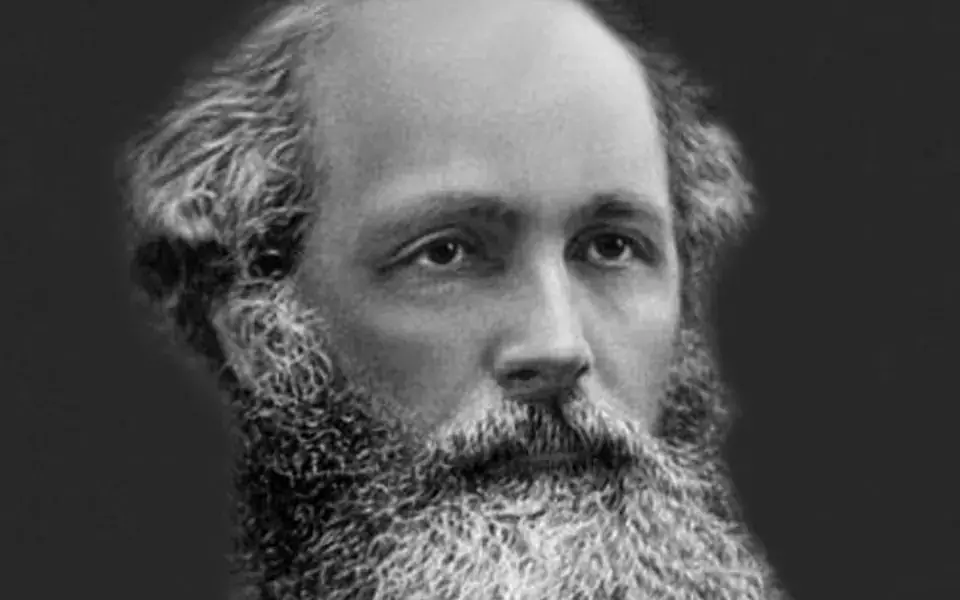
James Clerk Maxwell described electromagnetic fields mathematically. The predicted speed of their propagation was close to the speed of light, encouraging the view that light is an electromagnetic wave.
Later experiments confirmed the existence of electromagnetic waves. The familiar equations bearing his name were subsequently reorganized and do not exactly reproduce the form of his original papers.
Electromagnetism
Maxwell had studied and commented on electricity and magnetism as early as 1855 when his paper "On Faraday's lines of force" was read to the Cambridge Philosophical Society. The paper presented a simplified model of Faraday's work and how electricity and magnetism are related. He reduced all of the current knowledge into a linked set of differential equations with 20 equations in 20 variables. This work was later published as "On Physical Lines of Force" in March 1861.
Around 1862, while lecturing at King's College, Maxwell calculated that the propagation speed of an electromagnetic field was approximately the known speed of light. He treated the agreement as evidence of a physical connection. Light could be understood as a disturbance of the same kind involved in electric and magnetic phenomena. This joined subjects previously studied through different experiments and made the behavior of light part of a broader electromagnetic theory. The argument depended on comparing a theoretical result with a measured physical quantity.
His famous twenty equations, in their modern form of partial differential equations, first appeared in fully developed form in his textbook A Treatise on Electricity and Magnetism in 1873. Most of this work was done by Maxwell at Glenlair during the period between holding his London post and his taking up the Cavendish chair. Oliver Heaviside reduced the complexity of Maxwell's theory down to four partial differential equations, known now collectively as Maxwell's Laws or Maxwell's equations. Although potentials became much less popular in the nineteenth century, the use of scalar and vector potentials is now standard in the solution of Maxwell's equations. His work achieved the second great unification in physics.
Maxwell expressed electromagnetism in the algebra of quaternions and made the electromagnetic potential the centerpiece of his theory. In 1881 Heaviside replaced the electromagnetic potential field by force fields as the centerpiece of electromagnetic theory. According to Heaviside, the electromagnetic potential field was arbitrary and needed to be "assassinated". (sic) A few years later there was a debate between Heaviside and Tate (sic) about the relative merits of vector analysis and quaternions. The result was the realization that there was no need for the greater physical insights provided by quaternions if the theory was purely local, and vector analysis became commonplace.
Maxwell was proved correct, and his quantitative connection between light and electromagnetism is considered one of the great accomplishments of 19th-century mathematical physics.
Maxwell also introduced the concept of the electromagnetic field in comparison to force lines that Faraday described. By understanding the propagation of electromagnetism as a field emitted by active particles, Maxwell could advance his work on light. At that time, Maxwell believed that the propagation of light required a medium for the waves, dubbed the luminiferous aether. Over time, the existence of such a medium, permeating all space and yet apparently undetectable by mechanical means, proved impossible to reconcile with experiments such as the Michelson–Morley experiment. Moreover, it seemed to require an absolute frame of reference in which the equations were valid, with the distasteful result that the equations changed form for a moving observer. These difficulties inspired Albert Einstein to formulate the theory of special relativity; in the process, Einstein dispensed with the luminiferous aether as "superfluous".
Kinetic theory and thermodynamics
Maxwell also investigated the kinetic theory of gases. He was key in the creation of statistical mechanics. Originating with Daniel Bernoulli, this theory was advanced by the successive labours of John Herapath, John James Waterston, James Joule, and particularly Rudolf Clausius, to such an extent as to put its general accuracy beyond a doubt; but it received enormous development from Maxwell, who in this field appeared as an experimenter (on the laws of gaseous friction) as well as a mathematician.