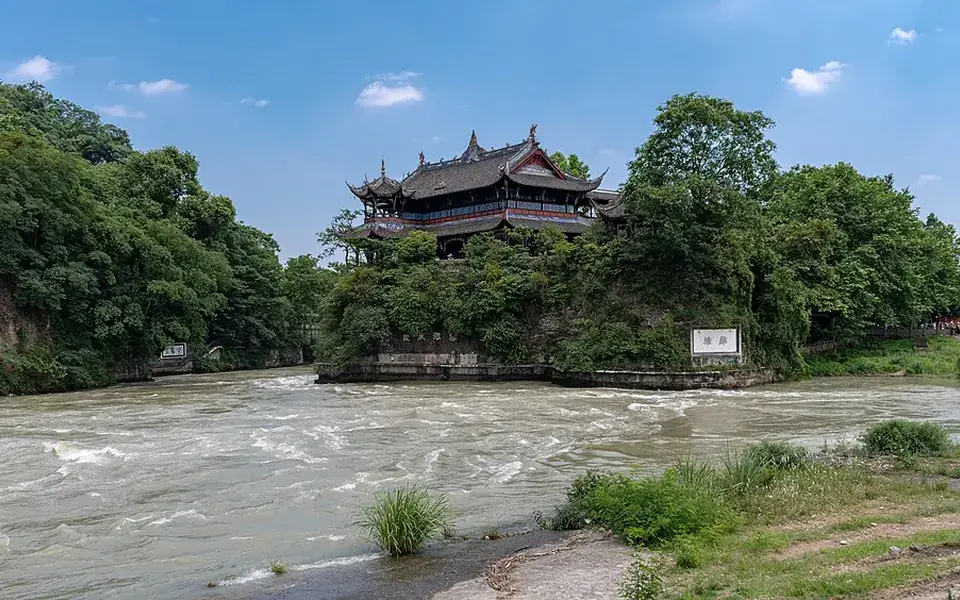
The Dujiangyan irrigation system uses structures including the Fish Mouth, Flying Sand Weir, and Bottle-Neck Channel to divide flows, discharge sediment, and divert water to irrigate the Chengdu Plain.
Adapted to the local terrain and the Min River's conditions, the system has continued to function through maintenance. It is not a single dam that completely blocks the river.
Planning
During the Warring States period, people who lived in the area of the Min River were plagued by annual flooding. Qin hydrologist Li Bing investigated the problem and discovered that the river was swelled by fast flowing spring melt-water from the local mountains that burst the banks when it reached the slow moving and heavily silted stretch below.
One solution would have been to build a dam, but the Qin wanted to keep the waterway open for military vessels to supply troops on the frontier, so instead an artificial levee was constructed to redirect a portion of the river's flow and then to cut a channel through Mount Yulei to discharge the excess water upon the dry Chengdu Plain beyond.
Construction
King Zhao of Qin allocated 100,000 taels of silver for the project and sent a team said to number tens of thousands. The levee was constructed from long sausage-shaped baskets of woven bamboo filled with stones known as Zhulong held in place by wooden tripods known as Macha. The construction of a water-diversion levee resembling a fish's mouth took four years to complete.
Cutting the channel proved to be a far greater problem, as the hand tools available at the time, prior to the invention of gunpowder, would have taken decades to cut through the mountain. Li Bing devised an ingenious method of using fire and water to rapidly heat and cool the rocks, causing them to crack and allowing them to be easily removed. After eight years of work, a channel 20 meters (66 ft) wide had been gouged through the mountain.
Irrigation head
The Yuzui or Fish Mouth Levee, named for its conical head that is said to resemble the mouth of a fish, is the key part of the construction. It is an artificial levee that divides the water into inner and outer streams. The inner stream is deep and narrow, while the outer stream is relatively shallow but wide. This special structure ensures that the inner stream carries approximately 60% of the river's flow into the irrigation system during dry season. While during flood, this amount decreases to 40% to protect the people from flooding. The outer stream drains away the rest, flushing out much of the silt and sediment.
The Feishayan or Flying Sand Weir has a 200-meter (660 ft)-wide opening that connects the inner and outer streams. This ensures against flooding by allowing the natural swirling flow of the water to drain out excess water from the inner to the outer stream. The swirl also drains out silt and sediment that failed to go into the outer stream. A modern reinforced concrete weir has replaced the original weighted bamboo baskets.
The Baopingkou or Bottle-Neck Channel, which was gouged through the mountain, is the final part of the system. The channel distributes the water to the farmlands in the Chengdu Plain, whilst the narrow entrance, that gives it its name, works as a check gate, creating the whirlpool flow that carries away the excess water over Flying Sand Fence, to ensure against flooding.