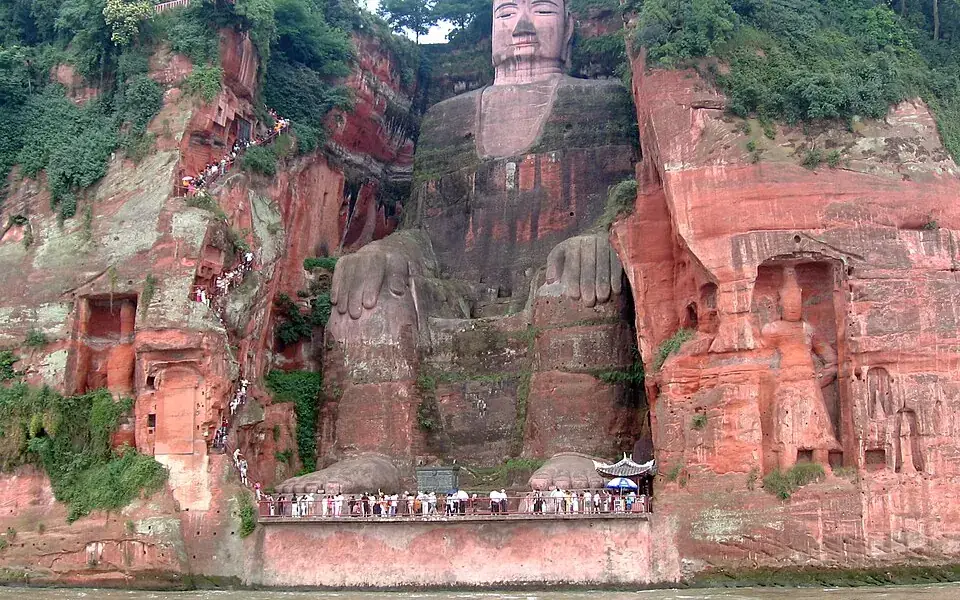
The Leshan Giant Buddha was carved into a mountainside. Channels and other drainage features in areas such as its hair and collar reduce damage caused by water accumulating over time.
Construction began in the Tang dynasty and continued for decades. Facing a confluence of rivers, the monument brings together faith, terrain, and engineering.
History
Construction started in 722 AD, led by a Chinese Buddhist monk named Hai Tong. He believed that Maitreya Buddha would calm the turbulent waters that constantly plagued the shipping vessels traveling down the river. When funding for the project was threatened, he is said to have gouged out his own eyes to show his piety and sincerity. After his death, however, the construction was delayed due to insufficient funding. The statue was only completed from the shoulders up at the time. Several years later, Hai Tong's disciples continued work on the statue with financial support from a local official named Zhangchou Jianxiong. Hai Tong's disciples continued the construction until the Knees, when construction was halted because Zhangchou JianXiang was called back to serve at the royal court in Chang'an.
About 70 years later, Jiedushi Wei Gao continued to support and funded the project and the construction was finally completed by Hai Tong's disciples in 803.
By the beginning of the Northern Song dynasty, the Leshan Giant Buddha had been damaged—the body was covered in moss, and the wooden pavilion had collapsed. During the reign of Song Renzong, the Giant Buddha was repaired once on a large scale and the wooden pavilion was rebuilt. Since then, the records of the destruction and reconstruction of the Buddha have been missing, and the original temple, Lingyun Temple, had been destroyed by war many times.
Apparently, the massive construction resulted in so much stone being removed from the cliff face and deposited into the river below that the currents were indeed altered by the statue, making the water safe for passing ships.
A sophisticated drainage system was incorporated into the Leshan Giant Buddha when it was built. It is still in working order. It includes drainage pipes carved into various places on the body, to carry away the water after the rains to reduce weathering.
When the Giant Buddha was carved, a huge thirteen-story wood structure (similar to the one at the Rongxian Giant Buddha) was built to shelter it from rain and sunshine. This structure was destroyed and sacked by the Mongols during the wars at the end of the Yuan dynasty. From then on, the stone statue was exposed to the elements.
Degradation
The Leshan Buddha has been affected by the pollution emanating from the unbridled development in the region. According to Xinhua news agency, the Leshan Giant Buddha and many Chinese natural and cultural heritage sites in the region have seen degradation from weathering, air pollution, and tourism. To address this issue, the government has promised restoration work. Furthermore, scientists have been investigating the interactions between the microbial community in the surrounding soil and above ground plants, and its effects on the sculpture. The body of The Giant Buddha of Leshan is covered today by different organisms, lichen, ferns and other bryophytes, and various shrubs and gramineous plants. Current research hopes that greater understanding of plant- and microbe-induced weathering effects may aid in the preservation of The Giant Buddha of Leshan.
Composition
The entire art piece is built in stone, except for the ears that were designed in wood, covered with mud on the surface to make clay, and attached to the head.
Drainage system
Between the two ears of the Buddha is an advanced drainage system that serves to preserve the statue from erosion. There are several hidden gutters and channels scattered within the Buddha's hair, collar, and chest areas, and holes in the back of his ears and chest that drain out rainwater to keep the interior dry. This architectural system has prevented the statue from eroding for the past 1,200 years.