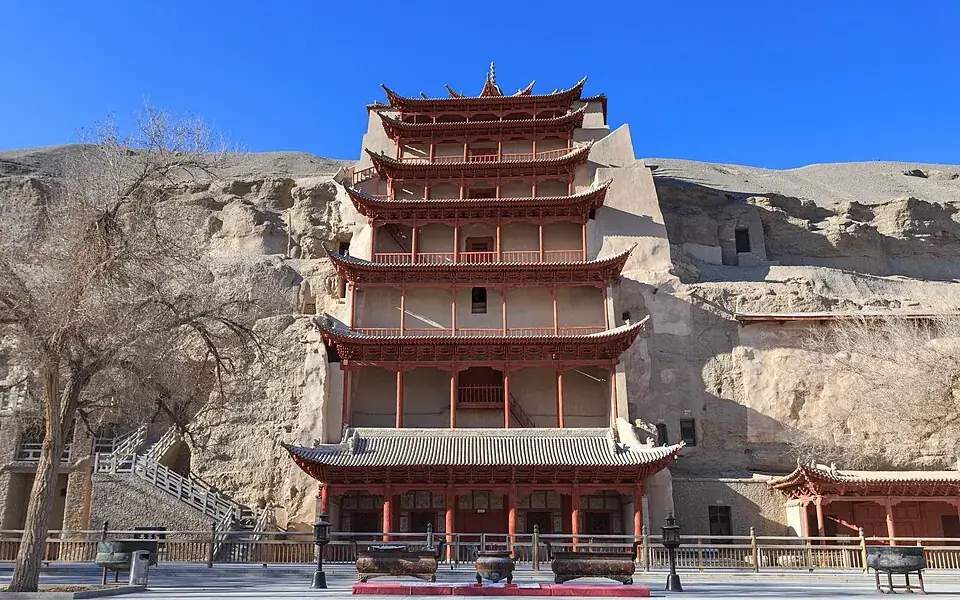
The Mogao Caves are a complex developed over a long period, rather than a building from a single era. Their murals, sculptures, and documents show the beliefs and arts of different times.
The caves stood within the Silk Road's transport environment, and their art absorbed diverse cultural influences. Conservation must manage the effects of windblown sand, humidity, and visitors.
A Buddhist site on the Silk Road
Dunhuang was established as a frontier garrison outpost by the Han dynasty Emperor Wudi to protect against the Xiongnu in 111 BC. It also became an important gateway to the West, a centre of commerce along the Silk Road, as well as a meeting place of various people and religions such as Buddhism. The Mogao Caves near Dunhuang were first constructed in the 4th century AD and were used as a site of Buddhist worship and pilgrimage. The caves contain over 400,000 square feet of frescoes and sculptures, making them one of the largest repositories of Buddhist art in the world.
Murals
The murals in the caves date from a period of over a thousand years, from the 5th to the 14th century, and many earlier ones were repainted at later points within the period. The murals are extensive, covering an area of 490,000 square feet (46,000 square metres). The most fully painted caves have paintings all over the walls and ceilings, with geometrical or plant decoration filling the spaces not taken by figurative images, which are above all of the Buddha. Sculpture is also brightly painted. The murals are valued for the scale and richness of content as well as their artistry. Buddhist subjects are most common, however some have traditional mythical subjects and portraits of patrons. These murals document the changing styles of Buddhist art in China for nearly a thousand years. The artistry of the murals reached its apogee during the Tang period, and the quality of the work dropped after the tenth century.
Early murals showed a strong Indian and Central Asian influence in the painting techniques used, the composition and style of the paintings as well as costumes worn by the figures, but a distinct Dunhuang style began to emerge during the Northern Wei dynasty. Motifs of Chinese, Central Asian and Indian origin may be found in a single cave, and Chinese elements increased during the Western Wei period.
A common motif in many caves is the areas entirely covered by rows of small seated Buddha figures, after which this and other "Thousand Buddhas Caves" are named. These small Buddhas were drawn using stencils so that identical figures may be replicated. Flying apsaras, or celestial beings may be depicted in the ceiling or above the Buddhas, and figures of donors may be shown along the bottom of the walls. The paintings often depict jataka tales which are stories of the life of Buddha, or avadana which are parables of the doctrine of karma. The murals may also depict religious themes.
Bodhisattvas started appearing during the Northern Zhou period, with Avalokitesvara (Guanyin), which was originally male but acquired female characteristics later, the most popular. Most caves show Mahayana and Sravakayana (Theravada or Hinayana) influences, although Mahayana Buddhism became the dominant form during the Sui dynasty. An innovation of the Sui-Tang period is the visual representation of the sutra – Mahayana Buddhist teachings transformed into large complete and detailed narrative paintings. One of the central features of Tang art in Mogao is the representation of the paradise of the Pure Land, indicating the increasing popularity of this school of Mahayana Buddhism in the Tang era. The Western Paradise Illustration of Cave 220 is a well-preserved mural of this type. The iconography of Tantric Buddhism, such as the eleven-headed or thousand-armed Avalokitesvara, also started to appear in Mogao wall paintings during the Tang period. It became popular during the Tibetan occupation of Dunhuang and the subsequent periods, especially during the Yuan dynasty.