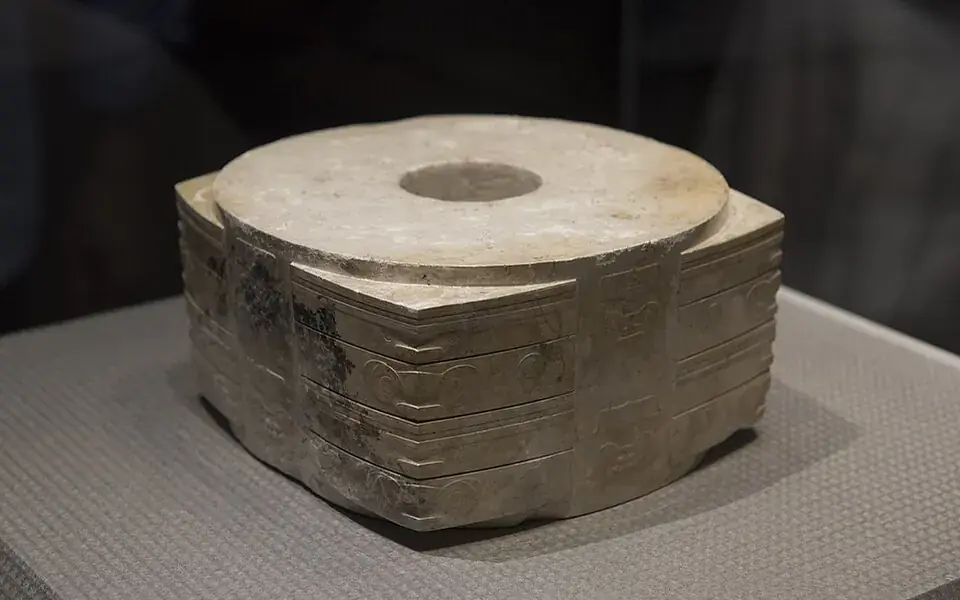
The Liangzhu culture is known for fine jade objects, cemeteries, and urban remains. Large associated waterworks show that people organized extensive labor to manage their water environment.
Objects such as jade cong have distinctive forms and patterns. Archaeological evidence helps investigate hierarchy, belief, and technology in the prehistoric lower Yangtze region.
City-building and agriculture
The culture possessed advanced agriculture, including irrigation, paddy rice cultivation and aquaculture. Houses were often constructed on stilts, on rivers or shorelines.
A new discovery of ancient city wall base relics was announced by the Zhejiang provincial government on November 29, 2007. It was concluded that the site was the center of the Liangzhu culture. A new Liangzhu Culture Museum was completed in 2008 and opened late in the year.
The Liangzhu Ancient City is located in a wetland environment on the plain of river networks between Daxiong Mountain and Dazhe Mountain of the Tianmu Mountain Range. This ancient city is said to be the largest city during this time period. Its interior area is 290 hectares, surrounded by clay walls which had six city gates. Two gates were located in the north, east and south walls. At its center was a confirmed palace site called the Mojiaoshan complex that spanned 30 hectares and there was also evidence of an artificial flood protection design implemented within the city. Both of these constructions are said to be indicators of the social complexity developing in Liangzhu at the time. A granary may have been in place containing up to 15,000 kg of rice grain.
There are numerous waterway entrances both inside and outside of the city, linking it to the river networks. Inside the city were artificial earth mounds and natural hills. Outside of the walled area, remains are found for 700 hectares, the residences are said to be built in an urban planning system. 8 kilometers to the north various dam-like sites were found and are speculated to be an ancient flood protection system. Also discovered inside and outside the city are a large number of utensils for production, living, military and ritual purposes represented by numerous delicate Liangzhu jade wares of cultural profoundness; the remains including city walls, foundations of large structures, tombs, altars, residences, docks and workshops. The Liangzhu city-site is said to have been settled and developed with a specific purpose in mind since this area has very few remains that can be traced back to earlier periods.
A typical Liangzhu community, of which there are over 300 found so far, chose to live near rivers. Boats and oars have been recovered, which indicates proficiency with boats and watercraft. A Liangzhu site has provided the remains of a wooden pier and an embankment thought to have been used for protection against floods. Houses were raised on wood also to help against flooding, although houses on higher ground included semi-subterranean houses with thatched roofs. Well technology at the Miaoqian site during this period was similar to that of the earlier Hemudu period. The Liangzhu culture is said to have been more socially developed and complex than northern contemporaries in the Han Valley.
Jade work
The Liangzhu "ancient city" or Liangzhu site-complex controlled the best jade products, but less important centers also produced elite crafts, which led researchers to believe the Liangzhu culture was not a simple pyramid structure society in terms of status levels. Many minor centers had access to their own jade (nephrite). However, the Liangzhu elites at the ancient city communicated and exchanged goods with elites from other parts of the Liangzhu world (and also in other regions of Longshan-era China) and set the criteria of what jade should look like. The Liangzhu did not seem to be importers of jade, even though they did export it extensively.