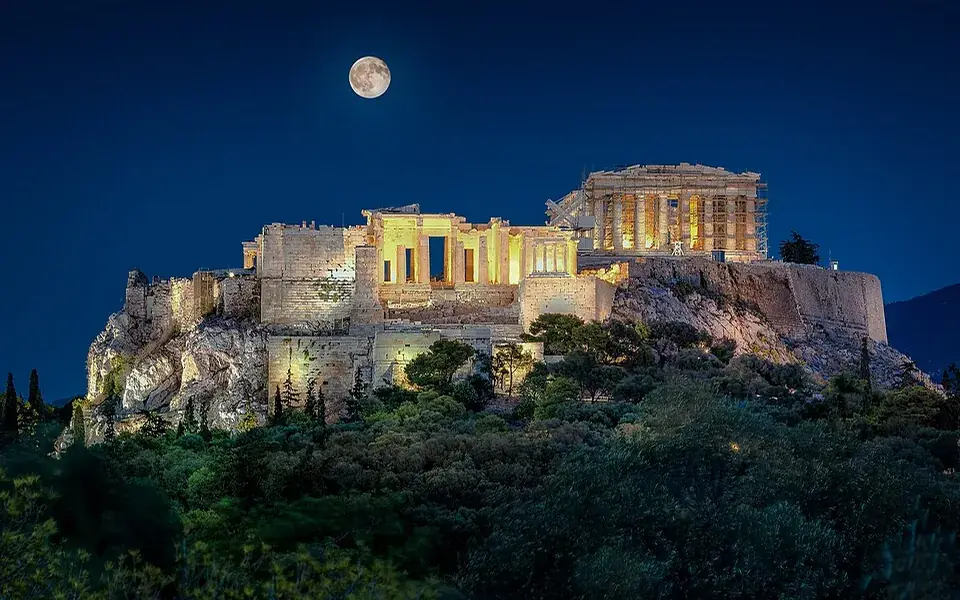
The Acropolis of Athens is more than one temple. It is an elevated complex containing the Parthenon, the monumental gateway, and other structures associated with religious ceremonies.
The hill was repeatedly used in different historical periods. Classical construction left famous remains, whose modern conservation must consider both structure and materials.
The Periclean building program
After winning at Eurymedon during 468 BC, Cimon and Themistocles ordered the reconstruction of the southern and northern walls of the Acropolis. Most of the major temples, including the Parthenon, were rebuilt by order of Pericles during the so-called Golden Age of Athens (460–430 BC). Phidias, an Athenian sculptor, and Ictinus and Callicrates, two famous architects, were responsible for the reconstruction.
During 437 BC, Mnesicles started building the Propylaea, a monumental gate at the western end of the Acropolis with Doric columns of Pentelic marble, built partly upon the old Propylaea of Peisistratos. These colonnades were almost finished during 432 BC and had two wings, the northern one decorated with paintings by Polygnotus. About the same time, south of the Propylaea, building started on the small Ionic Temple of Athena Nike in Pentelic marble with tetrastyle porches, preserving the essentials of Greek temple design. After an interruption caused by the Peloponnesian War, the temple was finished during the time of Nicias' peace, between 421 BC and 409 BC.
Construction of the elegant temple of Erechtheion in Pentelic marble (421–406 BC) was by a complex plan which took account of the extremely uneven ground and the need to circumvent several shrines in the area. The entrance, facing east, is lined with six Ionic columns. Unusually, the temple has two porches, one on the northwest corner borne by Ionic columns, the other, to the southwest, supported by huge female figures or caryatids. The eastern part of the temple was dedicated to Athena Polias, while the western part, serving the cult of the archaic king Poseidon-Erechtheus, housed the altars of Hephaestus and Voutos, brother of Erechtheus. Little is known about the original plan of the interior, which was destroyed by fire during the first century BC and has been rebuilt several times.
During the same period, a combination of sacred precincts including the temples of Athena Polias, Poseidon, Erechtheus, Cecrops, Herse, Pandrosos and Aglauros, with its Kore Porch (Porch of the Maidens) or Caryatids' Balcony was begun. Between the temple of Athena Nike and the Parthenon, there was the Sanctuary of Artemis Brauronia (or the Brauroneion), the goddess represented as a bear and worshipped in the deme of Brauron. According to Pausanias, a wooden statue or xoanon of the goddess and a statue of Artemis made by Praxiteles during the 4th century BC were both in the sanctuary.
Behind the Propylaea, Phidias' gigantic bronze statue of Athena Promachos ("Athena who fights in the front line"), built between 450 BC and 448 BC, dominated. The base was 1.50 m (4 ft 11 in) high, while the total height of the statue was 9 m (30 ft). The goddess held a lance, the gilt tip of which could be seen as a reflection by crews on ships rounding Cape Sounion, and a giant shield on the left side, decorated by Mys with images of the fight between the Centaurs and the Lapiths. Other monuments that have left almost nothing visible to the present day are the Chalkotheke, the Pandroseion, Pandion's sanctuary, Athena's altar, Zeus Polieus's sanctuary and, from Roman times, the circular Temple of Roma and Augustus.
Archaeological remains
The entrance to the Acropolis was a monumental gateway termed the Propylaea. To the south of the entrance is the tiny Temple of Athena Nike. At the centre of the Acropolis is the Parthenon or Temple of Athena Parthenos (Athena the Virgin). East of the entrance and north of the Parthenon is the temple known as the Erechtheum. South of the platform that forms the top of the Acropolis there are also the remains of the ancient, though often remodelled, Theatre of Dionysus. A few hundred metres away, there is the now partially reconstructed Odeon of Herodes Atticus.
Many of the valuable ancient artifacts are situated in the Acropolis Museum, which resides on the southern slope of the same rock, 280 metres from the Parthenon.