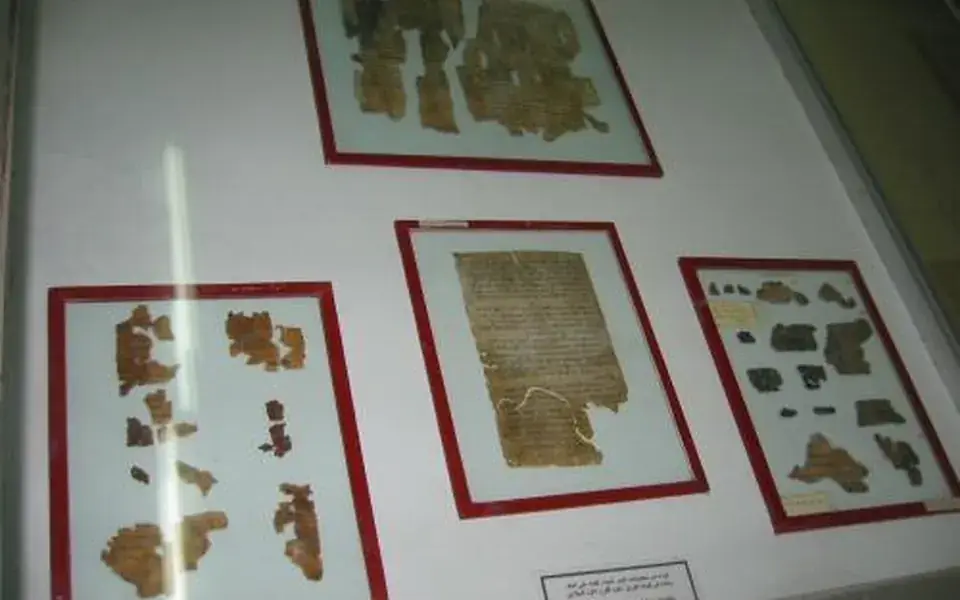
The Dead Sea Scrolls are a collection of ancient documents discovered in the 20th century in caves near the Dead Sea. They include religious manuscripts and other texts, rather than a single complete book.
Written on parchment and other materials in Hebrew and additional languages, they provide evidence for studying ancient Jewish society and the transmission of texts.
Initial discovery (1946–1947)
The initial discovery by Bedouin shepherd Muhammed edh-Dhib, his cousin Jum'a Muhammed, and Khalil Musa took place between November 1946 and February 1947. The shepherds discovered seven scrolls housed in jars in a cave near what is now known as the Qumran site. John C. Trever reconstructed the story of the scrolls from several interviews with the Bedouins. Edh-Dhib's cousin noticed the caves, but edh-Dhib was the first to actually fall into one (the cave now called Cave 1). He retrieved a handful of scrolls, which Trever identifies as the Isaiah Scroll, Habakkuk Commentary, and the Community Rule, and took them back to the camp to show to his family. None of the scrolls were destroyed in this process. The Bedouins kept the scrolls hanging on a tent pole while they contemplated what they should do with them, periodically showing the scrolls to their people.
In 1947 the original seven scrolls caught the attention of Trever of the American Schools of Oriental Research (ASOR), who compared the script in the scrolls to the Nash Papyrus, the oldest biblical manuscript then known, and found similarities between them. In March the 1948 Arab–Israeli War prompted the move of some of the scrolls to Beirut, Lebanon, for safekeeping. On 11 April 1948, Millar Burrows, head of the ASOR, announced the discovery of the scrolls in a general press release.
Search for the Qumran caves (1948–1949)
Early in September 1948, Metropolitan bishop Mar Samuel brought some additional scroll fragments that he had acquired to professor Ovid R. Sellers, the succeeding director of ASOR. By the end of 1948, nearly two years after the discovery of the scrolls, scholars had yet to locate the original cave where the fragments had been found. With unrest in the country at that time, no large-scale search could be safely undertaken. Sellers tried to persuade the Syrians to assist in the search for the cave, but he was unable to pay their price. In early 1949, the government of Jordan granted permission to the Arab Legion to search the area in which the original Qumran cave was believed to exist. Consequently, Cave 1 was rediscovered on 28 January 1949 by Belgian United Nations observer captain Phillipe Lippens and Arab Legion captain Akkash el-Zebn.
Ink and parchment
The scrolls were analysed using a cyclotron at the University of California, Davis, where it was found that all black ink was carbon black. The red ink on the scrolls was found to be made with cinnabar (HgS, mercury sulfide). There are only four uses of this red ink in the entire collection of Dead Sea Scroll fragments. The black inks found on the scrolls are mostly made of carbon soot from olive oil lamps. Honey, oil, vinegar, and water were often added to the mixture to thin the ink to a proper consistency for writing. Galls were sometimes added to the ink to make it more resilient. In order to apply the ink to the scrolls, its writers used reed pens.
The Dead Sea Scrolls were written on parchment made of processed animal hide known as vellum (approximately 85.5–90.5% of the scrolls), papyrus (estimated at 8–13% of the scrolls), and sheets of bronze composed of about 99% copper and 1% tin (approximately 1.5% of the scrolls). For those scrolls written on animal hides, scholars with the Israeli Antiquities Authority (IAA), by use of DNA testing for assembly purposes, believe that there may be a hierarchy in the religious importance of the texts based on which type of animal was used to create the hide. Scrolls written on goat and calf hides are considered by scholars to be more significant in nature, while those written on gazelle or ibex are considered to be less religiously significant in nature.