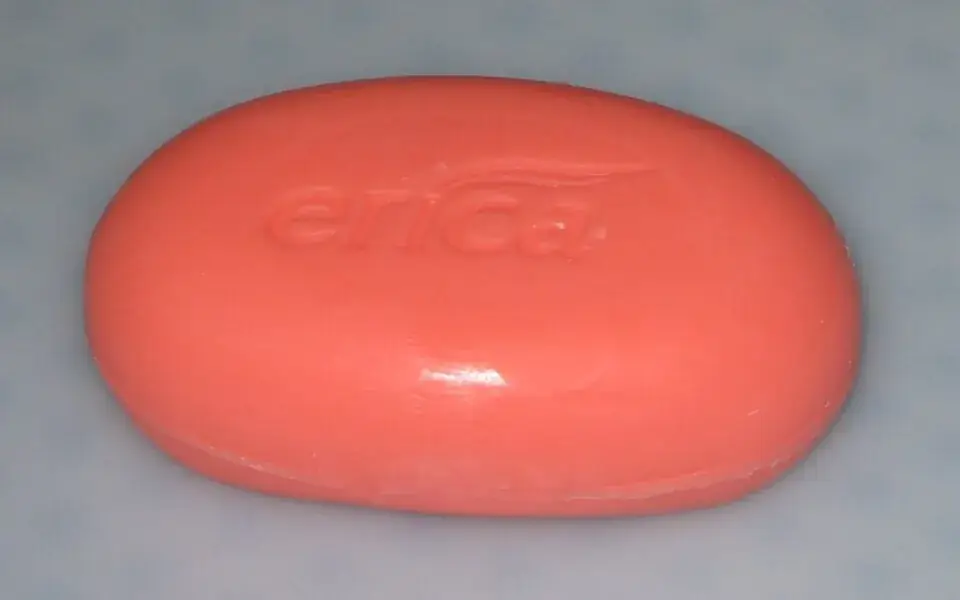
Soap is usually made by the saponification reaction between fats and alkali. Its molecules help disperse oily dirt in water, making it a cleaning material used over many centuries.
Similar cleaning materials existed in antiquity. Soap's growing popularity also depended on raw-material supplies, production methods, and changing ideas about hygiene.
Ancient world
Proto-soaps, which mixed fat and alkali and were used for cleansing, are mentioned in Sumerian, Babylonian, and Egyptian texts.
The earliest recorded evidence of the production of soap-like materials dates back to around 2800 BC in ancient Babylon. A formula for making a soap-like substance was written on a Sumerian clay tablet around 2500 BC. This was produced by heating a mixture of oil and wood ash, the earliest recorded chemical reaction, and used for washing woolen clothing.
The Ebers papyrus (Egypt, 1550 BC) indicates the ancient Egyptians used a soap-like product as a medicine and created this by combining animal fats or vegetable oils with a soda ash substance called trona. Egyptian documents mention a similar substance was used in the preparation of wool for weaving.
In the reign of Nabonidus (556–539 BC), a recipe for a soap-like substance consisted of uhulu (ashes), cypress, and sesame "for washing the stones for the servant girls".
True soaps, which might be recognised as soaps today, were different from proto-soaps. They foamed, were made deliberately, and could be produced in a hard or soft form because of an understanding of lye sources. It is uncertain who invented true soap, which may have been independently invented by various societies.
Knowledge of how to produce true soap emerged at some point between early mentions of proto-soaps and the first century AD. Alkali was used to clean textiles such as wool for thousands of years, but soap forms only when there is enough fat, and experiments show that washing wool does not create visible quantities of soap. Experiments by Sally Pointer show that the repeated laundering of materials used in perfume-making lead to noticeable amounts of soap forming. This fits with other evidence from Mesopotamian culture.
The ancient Romans did not use soap till at least the first century AD. At that time, the preferred Roman method of cleaning the body was to massage oil into the skin and then scrape away both the oil and any dirt with a strigil, whose standard design was a curved blade with a handle, all made of metal. Pliny the Elder, whose writings chronicle first-century life, describes soap as "an invention of the Gauls".
Islamic Golden Age
Hard toilet soap with a pleasant smell was produced in West Asia and North Africa during the Islamic Golden Age, when soap-making became an established industry. Recipes for soap-making are described by Muhammad ibn Zakariya al-Razi (c. 865–925 AD), who also gave a recipe for producing glycerine from olive oil. In West Asia, soap was produced from the interaction of fatty oils and fats with alkali. In Syria, soap was produced using olive oil together with alkali and lime. Soap was exported from Syria to other parts of the Muslim world and to Europe.
A twelfth-century document describes the process of soap production. It mentions the key ingredient, alkali, which later became crucial to modern chemistry, derived from al-qaly or "ashes".
By the thirteenth century, the manufacture of soap in West Asia and North Africa had become a major cottage industry, with sources in Nablus, Fes, Damascus, and Aleppo.
Medieval Europe
Soapmakers in Naples (then under the control of the Eastern Roman Empire) were members of a guild in the late sixth century, and in the eighth century, soap-making was well known in Italy and Spain. The Carolingian capitulary De Villis, dating to around 800, representing the royal will of Charlemagne, mentions soap as being one of the products the stewards of royal estates are to tally. The lands of Medieval Spain were a leading soapmaker by 800, and soapmaking began in the Kingdom of England about 1200. Soapmaking is mentioned both as "women's work" and as the produce of "good workmen" alongside other necessities, such as the produce of carpenters, blacksmiths, and bakers.
In Europe, soap in the 9th century was produced from animal fats and had an unpleasant smell. This changed when olive oil began to be used in soap formulas instead, after which much of Europe's soap production moved to the Mediterranean olive-growing regions. Hard toilet soap was introduced to Europe by Arabs and gradually spread as a luxury item. It was often perfumed.