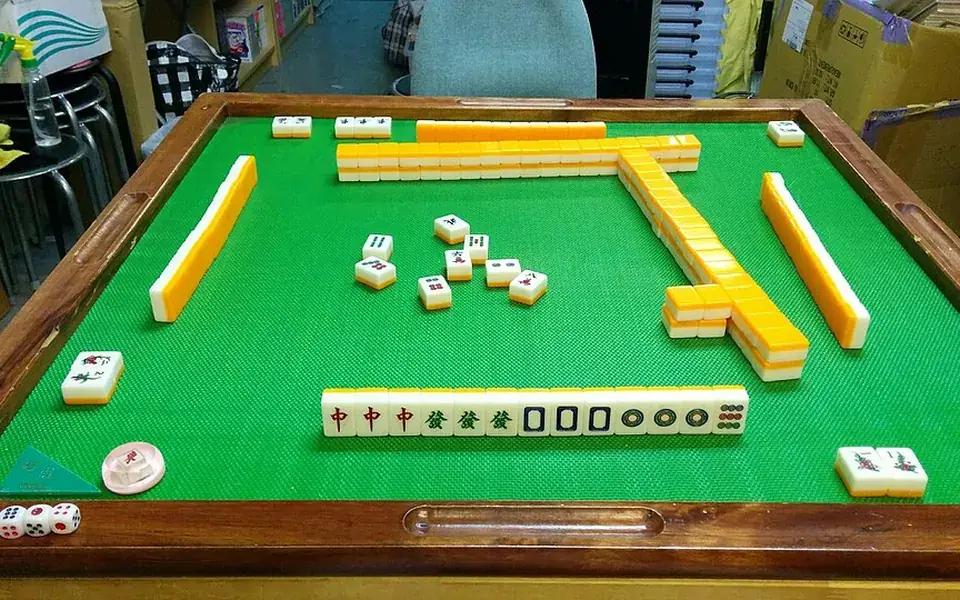
Mahjong mainly uses numbered dot, bamboo, and character tiles, together with honor tiles. Regional versions add flower tiles and special rules, creating varied ways to play and score.
Mahjong's development is associated with card and tile games in modern-era China. Popular origin legends should not all be accepted as established historical facts.
The development of mahjong
Accounts of mahjong's origins have pointed to both Ningbo and Fujian. In Illustrated Mahjong Guide, published in 1914, Yifan Shen placed the game's emergence in Ningbo roughly thirty years earlier, in the late nineteenth century. Writing in Endless History in 1933, the scholar Yaquan Du instead associated its early popularity with fishermen in Guangdong and Fujian. Du described the game as subsequently spreading among businessmen in Ningbo during the early years of the Guangxu reign. These differing accounts show why a single precise birthplace should be treated cautiously.
Roughly speaking, mahjong started in late Qing, around the 19th century, with different scholars debating its actual year of invention. Late Qing scholar, lecturer of the Shanghai Jiaotong University, Zhixian Xu wrote in the book "Folklore of the Ten Leaves" that the popularity of mahjong grew in the last years of Guangxu (after the end of the First Sino-Japanese War in 1895). One can conclude that the decades between the late 19th century to the early 20th century were the infant years of mahjong.
Mahjong is based on draw-and-discard card games that were popular in 18th and 19th century China, some of which are still popular today. They were played with a stripped deck of money-suited cards. Each deck is divided into three suits of Cash or coins, Strings of cash, and Myriads of strings. There are nine ranks in each suit. In addition, there are three wild cards: Red flower, White flower, and Old thousand. Depending on the game, there are multiple copies of each card.
Games scholar David Parlett has written that the Western card games Conquian and Rummy share a common origin with Mahjong. All these games involve players drawing and discarding tiles or cards to make melds. Khanhoo is an early example of such a game. The most likely ancestor to Mahjong was pènghú which was played with 120 or 150 cards. During the late 19th century, pènghú was used interchangeably with máquè in both card and tile form.
It is not known when the conversion from cards to tiles took place precisely but it most likely occurred in the middle of the 19th century. The earliest surviving tile sets date to around 1870 and were acquired in Fuzhou, Shanghai, and Ningbo. These sets differ from modern ones in several ways, there were no "flower" and fā ("green dragon") tiles. In their place were "king" tiles for heaven, earth, man, and harmony and also for each of the 4 "winds" which may have acted as bonus tiles. In the contemporaneous Himly set, there were no zhōng ("red dragon") tiles either. Instead there were the wild cards known as Cash Flower, String Flower, and Myriad Flower plus an additional tile, the king of everything. These early jokers are still found in Vietnamese sets.
Suited tiles
Suited tiles are divided into three suits and each are numbered from 1 to 9. The suits are bamboos, dots, and characters. There are four identical copies of each suited tile, totaling 108 tiles.
The bamboo suit is also known as "sticks", "strings", or "bams" suit; the first tile usually has a bird (traditionally, a peacock or sparrow) instead of a single bamboo. The dots suit is also known as the "wheels", "circles", "coins", "stones", "marbles" or "balls" suit. The characters suit is also known as the "myriads", "cracks" or "numbers" suit since the top characters are numbers in the Chinese writing system, and the bottom characters (in traditional Chinese characters) are the Chinese character for "ten thousand".
Honors tiles
There are two different sets of honors tiles: winds and dragons. The winds are east, south, west, and north, beginning with east. The dragons are red, green, and white. The white dragon has a blue or black frame on the face of the piece, or in some sets, is entirely blank. These tiles have no numerical sequence like the suited tiles (for example, the bamboo pieces numbered 1 to 9). Like the suited tiles, there are four identical copies of each honors tile, for a total of 28 honors tiles.