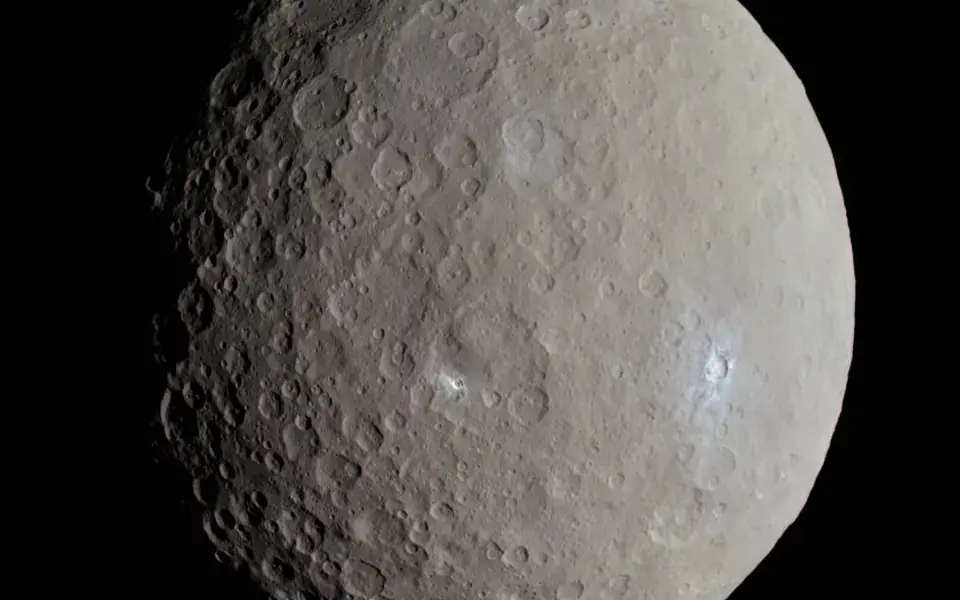
Giuseppe Piazzi discovered Ceres in 1801. Initially considered a planet and later classified as an asteroid, it is now classified internationally as a dwarf planet.
Ceres lies in the asteroid belt between Mars and Jupiter. Its changing classification reflects the discovery of more celestial objects and the revision of classification criteria.
Discovery
One of the astronomers selected for the search was Giuseppe Piazzi, a Catholic priest at the academy of Palermo, Sicily. Before receiving his invitation to join the group, Piazzi discovered Ceres on 1 January 1801. He was searching for "the 87th of the Catalogue of the Zodiacal stars of Mr la Caille", but found that "it was preceded by another". Instead of a star, Piazzi had found a moving starlike object, which he first thought was a comet. Piazzi observed Ceres twenty-four times, the final sighting occurring on 11 February 1801, when illness interrupted his work. He announced his discovery on 24 January 1801 in letters to two fellow astronomers, his compatriot Barnaba Oriani of Milan and Bode in Berlin.
He reported it as a comet, but "since its movement is so slow and rather uniform, it has occurred to me several times that it might be something better than a comet". In April, Piazzi sent his complete observations to Oriani, Bode, and French astronomer Jérôme Lalande. The information was published in the September 1801 issue of the Monthly Correspondence.
By this time, the apparent position of Ceres had changed (primarily due to Earth's motion around the Sun) and was too close to the Sun's glare for other astronomers to confirm Piazzi's observations. Towards the end of the year, Ceres should have been visible again, but after such a long time, it was difficult to predict its position. To recover Ceres, the mathematician Carl Friedrich Gauss, then twenty-four years old, developed an efficient method of orbit determination. He predicted the path of Ceres within a few weeks and sent his results to von Zach. On 31 December 1801, von Zach and fellow celestial policeman Heinrich W. M. Olbers found Ceres near the predicted position and continued to record its position.
Classification
The categorisation of Ceres has changed more than once and has been the subject of some disagreement. Bode believed Ceres to be the "missing planet" he had proposed to exist between Mars and Jupiter. Ceres was assigned a planetary symbol and remained listed as a planet in astronomy books and tables (along with Pallas, Juno, and Vesta) for over half a century.
As other objects were discovered in the neighbourhood of Ceres, astronomers began to suspect that it represented the first of a new class of objects. When Pallas was discovered in 1802, Herschel introduced the term asteroid ("star-like") for these bodies, writing that "they resemble small stars so much as hardly to be distinguished from them, even by very good telescopes". In 1852 Johann Franz Encke, in the Berliner Astronomisches Jahrbuch, declared the traditional system of granting planetary symbols too cumbersome for these new objects and introduced a new method of placing numbers before their names in order of discovery. The numbering system initially began with the fifth asteroid, 5 Astraea, as number 1, but in 1867, Ceres was adopted into the new system under the name 1 Ceres.
Ceres is designated as a dwarf planet and an asteroid. A NASA webpage states that Vesta, the belt's second-largest object, is the largest asteroid. The IAU has been equivocal on the subject, though its Minor Planet Center, the organisation charged with cataloguing such objects, notes that dwarf planets may have dual designations, and the joint IAU / USGS / NASA Gazetteer categorises Ceres as both asteroid and a dwarf planet.