Ancient temples and the rising reservoir
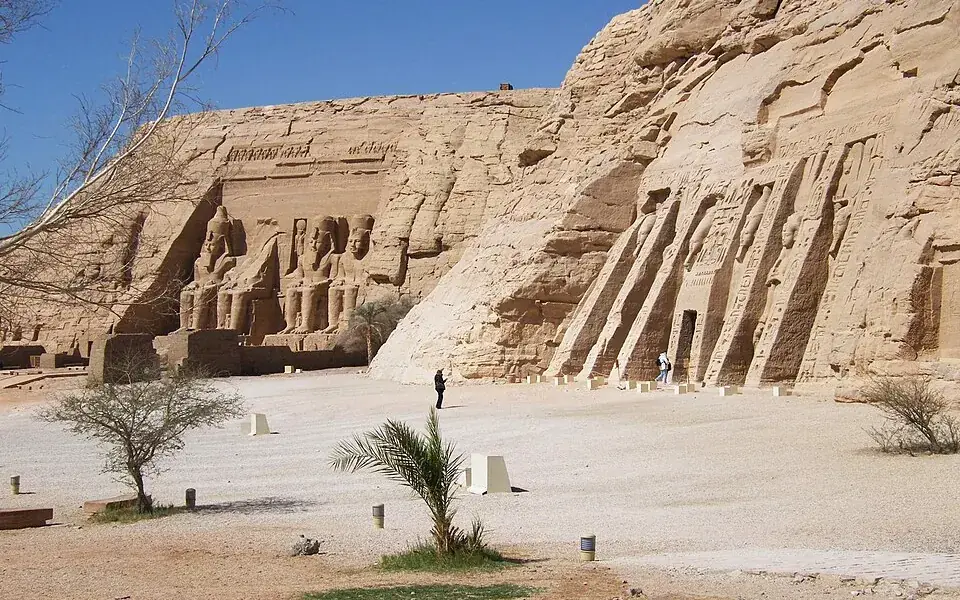
During his reign, Ramesses II embarked on an extensive building program throughout Egypt and Nubia, which Egypt controlled. As a major source of gold and many other precious trade goods, Nubia was of great importance to the Egyptians. He therefore built several grand temples in order to impress upon the Nubians Egypt's might and Egyptianize the people of Nubia. The most prominent temples are the rock-cut temples near the modern village of Abu Simbel, at the Second Nile Cataract, the border between Lower Nubia and Upper Nubia. There are two temples, the Great Temple, dedicated to Ramesses II himself, and the Small Temple, dedicated to his chief wife Queen Nefertari.
Construction of the temple complex started in c. 1264 BC and lasted for about 20 years, until 1244 BC. It was known as the Temple of Ramesses, Beloved by Amun.
Engineering proposals for rescue
Eventually two proposals were identified as being technically feasible. One from André Coyne and Jean Bellier, from the French engineering firm of Coyne et Bellier (now Tractebel Engineering) was for the temples to remain in position, protected by a curved 240 feet (73 m) high thin-walled concrete dam with a reflecting pool in front of the temples. Visitors would arrive by boat and disembark at the top of the dam. Pumps would be required to permanently manage the seepage of water from the lake through the dam.
This idea was dismissed due to the risks of the extensive drainage system failing but also due to its estimated cost of $82 million, high ongoing operating costs, and the belief that the temples would slowly be damaged by damp arising from capillary attraction. The second was from the Italian firm of Italconsult, following an idea by Pierre Gassola. They proposed cutting away the top of the cliff above the temples, before cutting behind them to sever them from the cliff. A reinforced concrete platform would then be inserted under them and after enclosing each in a massive concrete box they would then be raised on hydraulic jacks up 200 feet (61 m) to a higher location.
Cutting free the temples
In parallel with the creation of the cofferdam initial work at the temples themselves began with removing any loose rocks from between the two temples and deposited 5,000 truckloads of sand totalling 34,000 short tons (31,000 t) in front of their facades in protect them from any falling stones during the removal of the cliff face above them. The sand reached as high as the bottom of the uppermost frieze, which was itself protected by the construction of a temporary structure overtop of it. Steel tunnels were installed through the sand to allow workers to access the interior chambers of the temples. Inside they installed scaffolding to support the ceilings and walls, during removal of the cliff above them.
Initially excavators were used to remove the cliff from the uppermost 190 feet (58 m) of the cliff, but due to the increasing risk of damage from vibrations, pneumatic hammers were used to remove the remaining 60,000 short tons (54,000 t) to within 2.5 feet (0.76 m) of the ceiling and walls. In total approximately 300,000 tons of rock were removed to free the temples from the cliff. To assist in assessing where to make the required cuts the project team had the use of detailed drawings of the facades of the two temples which had prepared in 1959 by French National Geographic Institute.
Reassembling the temples
Meanwhile, in January 1966, work had commenced on constructing the foundations for the relocated temples: 208 m (682 ft) further inland and vertically 65 m (213 ft) higher for the Great Temple, and 67 m (220 ft) for the Small Temple. The temples were oriented at the new location to duplicate the two occasions each year that the rising sun penetrated the innermost sanctum at the rear of the Great Temple. To ensure the correct orientation, the permitted deviation when reassembling the Great Temple was plus or minus 5 mm. The inner walls and ceilings of the temple were reassembled first.
The interior joints were filled in by specialists from the Department of Antiquities, using a sand paste mixed to match the existing colours; while the wider cuts at the rear were filled in with a cement-based mortar. The facade of the temples were then reassembled, with the face of the first colossus reunited with its body on 14 September 1966. By the end of 1966, the reassembly of the 235 blocks making up the Small Temple was completed. Six weeks later, the reassembly of the 807 blocks making up the Great Temple was completed.