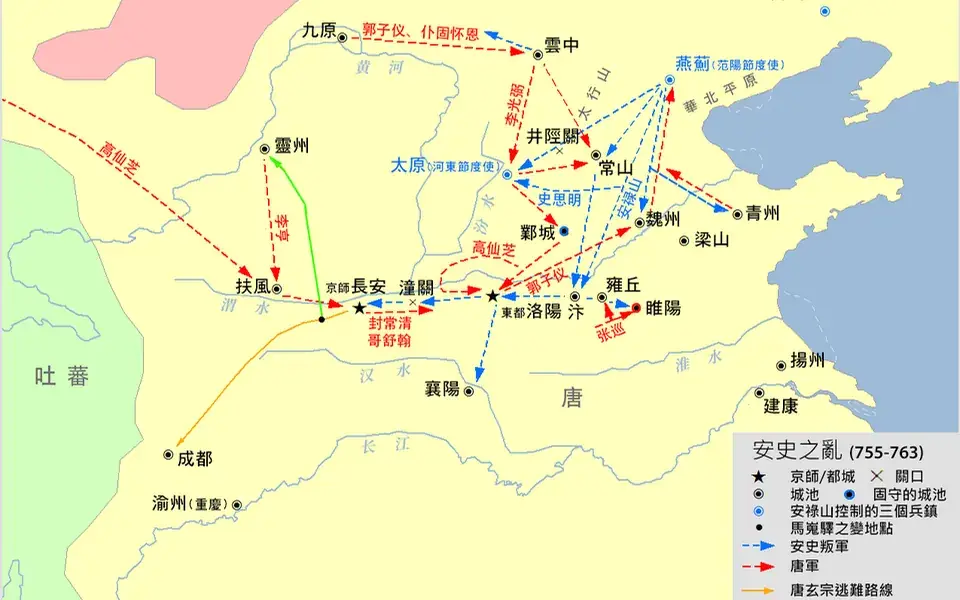
The An Lushan Rebellion began with An Lushan's uprising and continued for years, profoundly affecting population, finances, and relations between central and regional powers. The rebellion's end did not immediately restore earlier conditions everywhere. Regional military governors and related problems remained influential in later Tang politics.
Historical background
The An Lushan rebellion was a civil war in China that lasted from 755 to 763, at the approximate midpoint of the Tang dynasty (618–907). It began as a commandery rebellion attempting to overthrow and replace the Tang government with the rogue Yan dynasty. The rebels succeeded in capturing the imperial capital Chang'an after the emperor had fled to Sichuan, but eventually succumbed to internal divisions and counterattacks by the Tang and their allies. The rebellion spanned the reigns of three Tang emperors: Xuanzong, Suzong, and Daizong.
On 16 December 755, An Lushan, the jiedushi of the Taiyuan Commandery, mobilized his army and marched out of Fanyang. An Lushan led the rebellion for two years before he was assassinated by his son An Qingxu. Two years after An Qingxu's ascension, Shi Siming, the governor of Pinglu Commandery and a close ally of An Lushan, killed An Qingxu and usurped the leadership. Shi Siming ruled for two years, but was in turn killed by his own son Shi Chaoyi, who ruled for another two years until the Yan dynasty fell to Tang forces on 17 February 763.
Political
Beginning in 742, Eurasia entered a 13-year period of major political turmoil, with the regional empires generally suffering "a major rebellion, revolution, or dynastic change." In this year the Second Turkic Khaganate of the eastern Eurasian Steppe was overthrown and then replaced by Sogdian-influenced Uighur rulers. This was apparently the first of several revolutionary events either led by or intimately connected with the merchants and tradespeople involved with the international commerce often referred to as the Silk Road. In 747, the Abbasids began their rebellion against the Umayyad Caliphate in Merv, Khurasan, resulting in the proclamation of a new Abbasid Caliph in about 750. This rebellion also seems to have been organized by merchants and persons identifying themselves as merchants.
The western expansion of the Tang Empire was checked in 751 by the defeat of a large expeditionary force led by General Gao Xianzhi in the Battle of Talas in the modern Fergana Valley, with the Abbasid victory attributable to the defection of the Karluk Turks in the midst of the battle. However, the Arabs did not proceed any further after the battle, and the Tang retained their Tarim Basin territory until the An Lushan rebellion.
Flight of the emperor
With rebel forces clearly an imminent threat to the imperial seat of Chang'an, and with conflicting advice from his advisers, Tang emperor Xuanzong determined to flee to the relative sanctuary of Sichuan with its natural protection of mountain ranges so the Tang forces could reorganize and regroup. He brought along the bulk of his court and household. The route of travel from Chang'an to Sichuan was notoriously difficult, requiring hard travel on the way through the intervening Qin Mountains.
However, the geographical features of the terrain were not the only hardships on the journey: there was a matter that first had to be settled, involving the relationship between Xuanzong and the Yang family, especially the emperor's beloved Yang Guifei. So, before progressing more than a few kilometers along the way, an incident occurred at Mawei Inn, in today's Xingping in Xianyang, Shaanxi. Xuanzong's bodyguard troops were hungry and tired, and very angry with Yang Guozhong for exposing the whole country to danger.
Aftermath
The end of the rebellion was a long process of rebuilding and recovery. Due to the Imperial Court's weakened condition, other disturbances flared up. The Tibetan Empire under Trisong Detsän, taking advantage of the Tang's weakness, proceeded to briefly capture Chang'an on 18 November 763 before conquering much of the western half of Tang territories. In 765, Pugu Huai'en, allied with Uyghur and Tibetan forces launched another siege on Chang'an.
Furthermore, Yan generals who had surrendered to Tang were allowed by Emperor Daizong to retain as independent military governors (Jiedushi), this began an era of warlordism that plagued Tang for the rest of the dynasty.