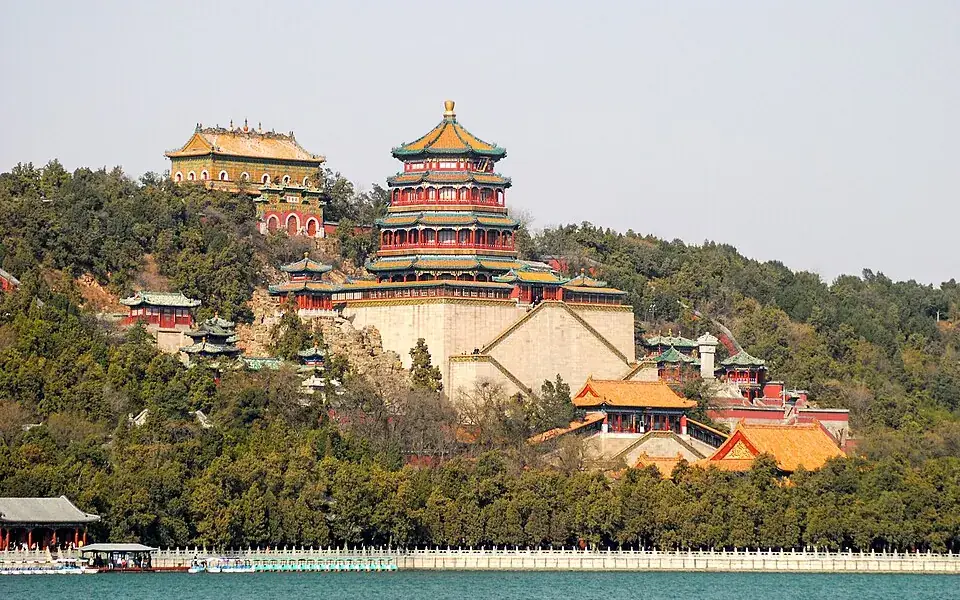
The Summer Palace combines Kunming Lake, Longevity Hill, palaces, covered corridors, and other buildings. Its landscape organizes routes and views while serving imperial residence and activities.
The garden underwent destruction and rebuilding, and its present landscape reflects construction in different periods. It combines natural scenery, engineering, and historical significance.
Pre-Qing dynasty
The origins of the Summer Palace date back to the Jurchen-led Jin dynasty. In 1153, when the fourth emperor Wanyan Liang (r. 1150–1161) moved the Jin capital from Huining Prefecture (in present-day Acheng District, Harbin, Heilongjiang) to Yanjing (present-day Beijing), he ordered the construction of a palace in the Fragrant Hills and Jade Spring Hill in what is now the northwest of Beijing.
Around 1271, after the Yuan dynasty established its capital in Khanbaliq (present-day Beijing), the engineer Guo Shoujing initiated a waterworks project to direct the water from Shenshan Spring in Baifu Village, Changping into the Western Lake, which would later become Kunming Lake. Guo aimed to create a water reservoir that would ensure a stable water supply for the palace.
In 1494, the Hongzhi Emperor (r. 1487–1505) of the Ming dynasty had a Yuanjing Temple built for his wet nurse, Lady Luo, in front of Jar Hill, which was later renamed Longevity Hill. The temple fell into disrepair over the years and was abandoned, and the area around the hill became lush with vegetation. The Zhengde Emperor (r. 1505–21), who succeeded the Hongzhi Emperor, built a palace on the banks of the Western Lake and turned the area into an imperial garden. He renamed Jar Hill "Golden Hill" and named the lake "Golden Sea". Both the Zhengde Emperor and the Wanli Emperor (r. 1572–1620) enjoyed taking boat rides on the lake. During the reign of the Tianqi Emperor (r. 1620–27), the court eunuch Wei Zhongxian took the imperial garden as his personal property.
Qing dynasty
In the early Qing dynasty, Jar Hill served as the site for horse stables in the imperial palace. Eunuchs who committed offences were sent there to weed and cut grass. At the beginning of the reign of the Qianlong Emperor (r. 1735–1796), many imperial gardens were built in the area around present-day Beijing's Haidian District and accordingly, water consumption increased tremendously. At the time, much of the water stored in the Western Lake came from the freshwater spring on Jade Spring Hill, while a fraction came from the Wanquan River. Any disruption of the water flow from Jade Spring Hill would have affected the capital's water transport and water supply systems.
Around 1749, the Qianlong Emperor decided to build a palace in the vicinity of Jar Hill and the Western Lake to celebrate the 60th birthday of his mother, Empress Dowager Chongqing. He ordered the Western Lake to be expanded further west to create two more lakes, Gaoshui Lake and Yangshui Lake, with the aim of improving the capital's waterworks system. The three lakes served not only as a reservoir for the imperial gardens but also as a source of water for the surrounding agricultural areas. The Qianlong Emperor collectively named the three lakes "Kunming Lake" after the Kunming Pool constructed by Emperor Wu (2nd century BC) in the Han dynasty for the training of his navy. The earth excavated from the expansion of Kunming Lake was used to enlarge Jar Hill, which was renamed "Longevity Hill".
The Summer Palace, whose construction was completed in 1764 at a cost of over 4.8 million silver taels, was initially named "Qingyiyuan".
The design of the Summer Palace was based on a legend in Chinese mythology about three divine mountains in the East Sea, namely Penglai, Fangzhang and Yingzhou. The three islands in Kunming Lake – Nanhu Island, Tuancheng Island and Zaojiantang Island – were made to represent the three mountains, while the lake itself was based on a blueprint of the West Lake in Hangzhou. Moreover, many architectural features in the palace were also built to resemble or imitate various attractions around China. For example, the Phoenix Pier represented Lake Tai; the Jingming Tower resembled Yueyang Tower, Hunan; the Wangchan Pavilion resembled Yellow Crane Tower; the shopping streets were designed to imitate those in Suzhou and Yangzhou. The centrepiece of the Summer Palace was the "Great Temple of Gratitude and Longevity". There was also a Long Corridor more than 700 metres (2,300 ft) long which was furnished with artistic decorations.