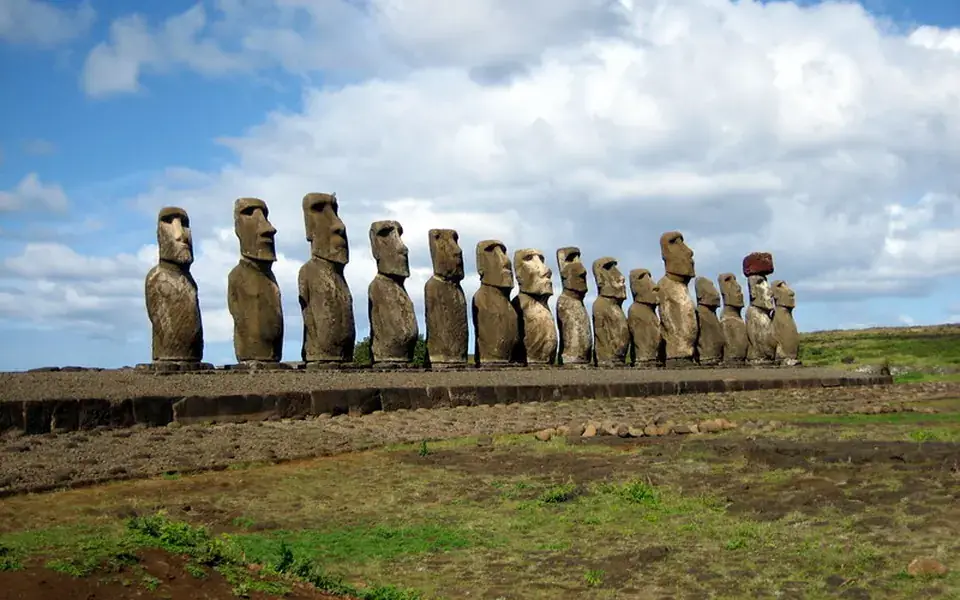
The moai of Easter Island are generally more than heads: many have torsos. The impression that only heads exist is related to later burial of parts of the statues.
The statues belong to Rapa Nui traditions of commemorating ancestors. Quarries, transport methods, and changes to the island's environment remain subjects of research.
Description
The moai are monolithic statues, and their minimalist style reflects forms found throughout Polynesia. Moai are carved from volcanic tuff (solidified ash). The human figures would be outlined in the rock wall first, then chipped away until only the image was left. The over-large heads (a three-to-five ratio between the head and the trunk, a sculptural trait consistent with the Polynesian belief in the sanctity of chiefly the head) have heavy brows and elongated noses with a distinctive fish-hook-shaped curl of the nostrils. The lips protrude in a thin pout. Like the nose, the ears are elongated and oblong in form. The jaw lines stand out against the truncated neck. The torsos are heavy; sometimes the clavicles are subtly outlined in stone too.
The arms are carved in bas relief and rest against the body in various positions, hands and long slender fingers resting along the crests of the hips, meeting at the hami (loincloth), with the thumbs sometimes pointing towards the navel. Generally, the anatomical features of the backs are not detailed, but sometimes bear a ring and girdle motif on the buttocks and lower back. Except for one kneeling moai, the statues do not have clearly visible legs.
Carving statues on Rapa Nui
The statues were carved by the aboriginal Polynesians of the island, mostly between 1250 and 1500. In addition to representing deceased ancestors, the moai, once they were erected on ahu (stone platforms), may also have been regarded as the embodiment of powerful living or former chiefs and important lineage status symbols. Each moai presented a status: "The larger the statue placed upon an ahu, the more mana the chief who commissioned it had." The competition for grandest statue was ever prevalent in the culture of the Easter Islanders. The proof stems from the varying sizes of moai.
Completed statues were moved to ahu mostly on the coast, then erected, sometimes with pukao, red stone cylinders, on their heads. Moai must have been very time-consuming to craft and transport; not only would the actual carving of each statue require effort and resources, but the finished product was then hauled to its final location and erected.
The quarries in Rano Raraku appear to have been abandoned abruptly, with a litter of stone tools and many completed moai outside the quarry awaiting transport and almost as many incomplete statues still in situ as were installed on ahu. In the nineteenth century, this led to conjecture that the island was the remnant of a sunken continent and that most completed moai were under the sea.
Symbolism
Archaeologists believe that the statues were a representation of the ancient Polynesians' ancestors. The moai statues face away from the ocean and towards the villages as if to watch over the people. An exception is the group of seven statues at Ahu Akivi, which face out to sea. There is a legend that says there were seven men who waited for their king to arrive. A study in 2019 concluded that ancient people believed that quarrying of the moai might be related to improving soil fertility and thereby critical food supplies.